

She says our reporting caused damages. The documents tell a different story.
OCEAN SPRINGS, MS (GC Wire) – A former spokesperson for the City of Ocean Springs says she’s embarrassed by a news article GC Wire published and is now demanding the city pay at least a half million dollars for what she considers a leak of her confidential information.
Laurri Garcia, who worked at City Hall for less than a year, filed a formal Notice of Claim with the City last month, the first step required before bringing certain lawsuits against a Mississippi city.
Her central claim is that city officials leaked sensitive information about her that eventually found its way to the Internet, causing embarrassment, emotional distress, reputational harm, and ultimately contributing to her departure from City Hall.
Garcia’s filing attributes those feelings – at least in part – to this outlet’s publication of information concerning her compensation and federal retirement situation.
But there is a significant problem with that narrative: The highly personal information Garcia now says was improperly disclosed was never actually published by GC Wire.
In fact, Garcia’s own publicly accessible Notice of Claim, submitted to the City by her attorney Edward Gibson, reveals substantially more about her personal finances, federal retirement benefits, tax circumstances, and employment history than anything GC Wire reported. The difference isn’t subtle.
GC Wire’s May 14 article addressed Garcia’s retirement situation in a single sentence, reporting that a proposed change in her employment arrangement “stemmed from complications involving Garcia’s federal retirement supplement from a previous employer and income limitations tied to her current City employment classification.”
That’s what we published. And that short line was necessary context to explain why the Board was considering changing how residents’ tax dollars were being spent.
We did not identify Garcia’s specific federal retirement benefit. We did not publish the applicable federal earnings threshold. We did not disclose the potential financial consequences Garcia faced, details surrounding preparation of her 2025 taxes, her security-clearance history, or her federal employment history.
But Garcia’s Notice of Claim did disclose those details. And more.
While the Notice is addressed to Mayor Bobby Cox and City Clerk Christine Millard, it repeatedly names GC Wire and this reporter. The filing ends by stating that if the matter cannot be resolved, Garcia will “file suit and proceed with an action against any and all liable parties, including but not limited to the City of Ocean Springs, Mississippi.”
But if Garcia is looking to sue someone for disclosing personal information, she should seriously consider suing her own attorney, rather than the city, individual aldermen, GC Wire, or me.
GC Wire acquired a copy of Garcia’s complaint through a public records request. We later issued an official response challenging her allegations point by point.
What Happened Behind Closed Doors
To understand Garcia’s demands, you first have to understand why the Board of Aldermen was discussing her employment behind closed doors in the first place.
According to her Notice of Claim, Garcia spent many years working for the federal government before joining Ocean Springs last August. While preparing her 2025 taxes, Garcia says she learned that her City income would exceed a federal earnings threshold affecting a retirement supplement she received from her former employer.
Her Notice describes that she privately approached Mayor Cox and City Clerk Millard about the issue because she wanted to remain employed by the City without suffering the financial consequences associated with exceeding that threshold.
The matter eventually made its way into a closed-door executive session of the April 7 Board of Aldermen meeting.
According to Garcia’s filing, she believed discussing the issue behind closed doors would protect all of her personal circumstances from public disclosure. Her attorney alleges the City failed to adequately safeguard that information and that the information from the executive session was subsequently disclosed.
But Garcia’s claim ultimately depends on more than whether information left the room. It depends on what information was actually made public, whether that information was legally protected in the first place, and whether its publication caused the damages she now claims.
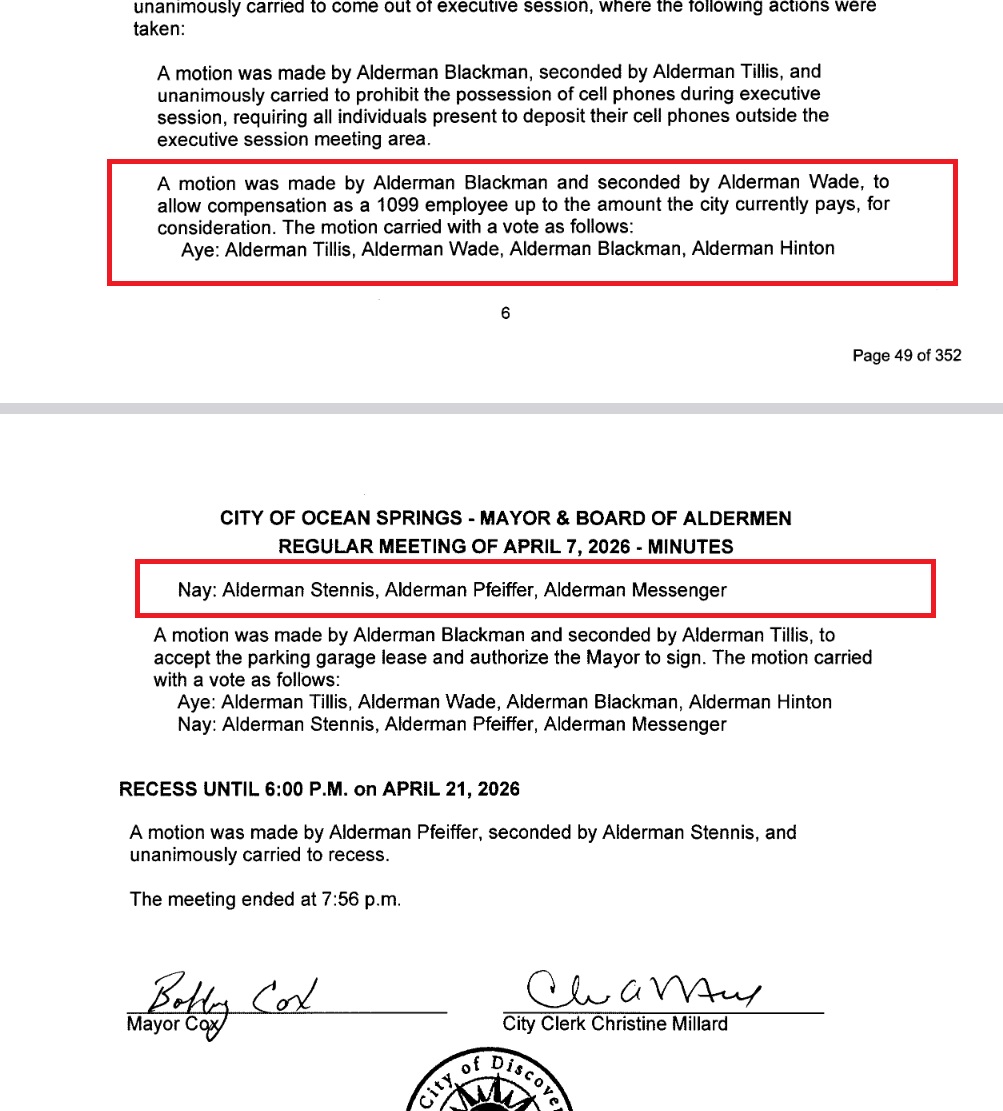
What is not disputed, however, is what happened when the Board returned to open session. According to the City’s official minutes, Alderman Rob Blackman made a motion, seconded by Alderman Kevin Wade, “to allow compensation as a 1099 employee up to the amount the city currently pays, for consideration.”
That cryptic passage in the city’s official record left many confused:
Who is the employee?
What is the job position?
And how much is this going to cost taxpayers?
These are standard questions that are supposed to be answered up front when municipalities take such actions.
Only after further investigation did we discover the subject of the motion was Laurri Garcia. The Board had debated transitioning Garcia’s full-time, hourly-wage position as the City’s public affairs officer into an independent contractor arrangement. The motion passed 4-3.
That public vote is important for two reasons. First, the existence of the proposed 1099 arrangement was no longer secret. The City itself recorded the action in its official minutes, and GC Wire reported the Board’s action on April 14 — a full month before our May 14 article eventually identified Garcia as the employee involved.
Second, Garcia’s Notice describes what happened that night very differently. Gibson writes that the Board “only agreed to consider the transition from employee to 1099 independent contractor at a future date,” describing the matter as “essentially tabled.” That’s difficult to reconcile with the City’s official record. The minutes don’t say the motion was tabled; they say it passed 4-3.
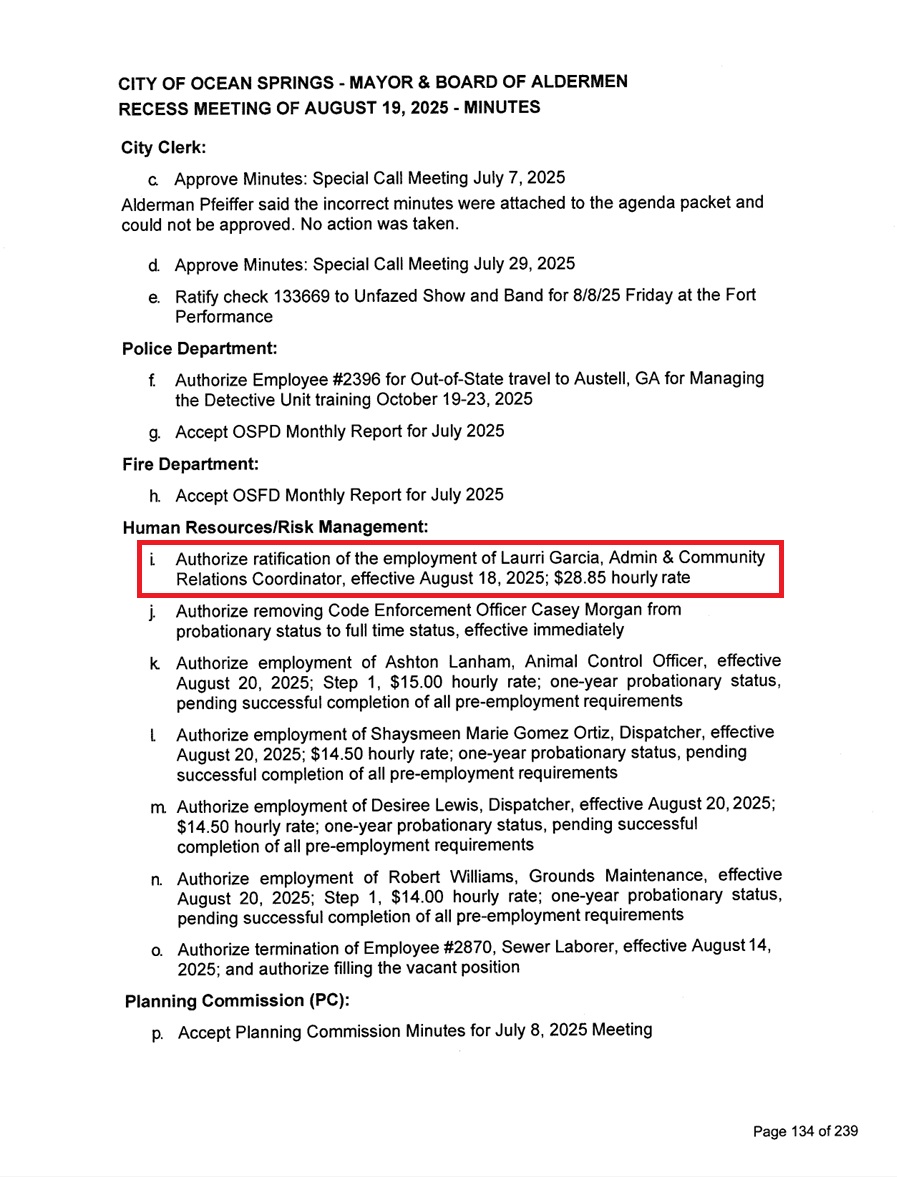
The one financial figure GC Wire did report — Garcia’s salary of roughly $60,000 annually — wasn’t confidential information either. When the City hired Garcia in August 2025, the Board’s publicly available minutes recorded her rate of pay at $28.85 per hour. At a standard 40-hour workweek, that equals approximately $60,000 annually.
It is standard practice for a city to publish the wages of municipal employees in the minutes of the meeting where an employee is approved to be hired. And the April 7 motion itself publicly tied the proposed contractor compensation to “the amount the city currently pays.”
In other words, readers didn’t need access to an executive session to know what Garcia earned. The City had already published it.
The article also reported concerns raised by Board members about the legitimacy of the proposed arrangement, its cost to taxpayers, and whether other City employees would demand similar treatment. Those concerns involved the Board’s handling of public business, not Garcia’s private financial information, and were verified by multiple sources.
Garcia’s Response Doesn’t Match Her Notice
Garcia’s Notice also reveals a striking discrepancy between what she told GC Wire before publication and what she says now.
One day before publishing the article, I emailed Garcia the exact language from the City’s April 7 minutes showing the Board’s 4-3 vote on the mysterious 1099 arrangement. I asked who was involved, what position had been created, how much it would cost, and why the action had been taken in private.
Garcia responded: “I have not been privy to conversations held in Executive Session. I can find no information that the Board of Alderman took any action to create such a position.”
A follow-up email attempted to refresh her memory, including a screenshot of the official City minutes documenting the 1099 motion and 4-3 vote. Garcia did not respond further, and we published her response verbatim.
Her Notice of Claim now confirms Garcia had personally approached the Mayor and City Clerk about her retirement problem, knew the matter was being presented to the Board, and expected the executive session to keep her personal circumstances private.
In other words, when GC Wire asked City Hall about the 1099 proposal she now admits was prompted by her own request for help, Garcia – who was the official city spokesperson – responded as though she knew nothing about it.
Our report exposed that discrepancy.
Three months later, Garcia’s Notice of Claim says she should now be compensated for the embarrassment caused by our article. But if the embarrassment came from GC Wire exposing that Garcia had not been candid with us about what she knew, perhaps she’s demanding compensation from the wrong people.
Maybe Garcia should sue herself.
Resignation Letter Told a Different Story
On May 22, Garcia sent an official resignation letter to the Mayor. She now says our article contributed to forcing her from City Hall, but her explanation at the time was different.
In that letter, Garcia cited a recent family tragedy that caused her to reevaluate her priorities and said she was leaving in the interest of her well-being and family.
The letter also raised generalized concerns about professionalism, confidentiality, political manipulation, personal attacks, and trust within City Hall. What she did not mention was GC Wire, the May 14 article, me, or public reporting about her compensation.
Three months later, her Notice of Claim now characterizes Garcia’s departure as a “constructive discharge” and specifically ties it to the April 7 executive session, alleged disclosures to me, subsequent publication, and the public discourse that followed.
That’s a substantially different explanation from the one Garcia gave when she actually resigned.
Was the Meeting Even Legal?
There is another major problem with Garcia’s claim: the government action at the center of this controversy arguably should never have been conducted behind closed doors in the first place.
Garcia’s personal financial circumstances may have been appropriate for private discussion. But the Board went further. It debated converting a City employee into an independent contractor and then voted 4-3 on compensation for the proposed 1099 arrangement.
Mississippi’s Attorney General has addressed that distinction directly by stating:
“There is no authority for the Board to enter into executive session to discuss the employment of an individual as an independent contractor.”
That turns Garcia’s allegation of an executive-session “leak” on its head. If anyone disclosed that the Board was privately debating and voting on governmental business that should have been conducted in public, that disclosure could reasonably be viewed less as leaking a protected secret and more as exposing government action the public had a right to know about.
More importantly, disclosure of executive-session discussions is not itself prohibited by Mississippi’s Open Meetings Act. In Attorney General Opinion No. 2006-0042, the State addressed that question directly when they wrote:
“There is nothing in the open meetings law that prohibits members of the board of aldermen from disclosing information discussed during executive sessions, nor does the law provide any penalties for those persons who disclose matters discussed in executive session.”
The AG’s opinion undermines a central premise running through Garcia’s Notice: that information was necessarily unlawful to disclose simply because it was discussed during an executive session.
If an alderman told a journalist that the Board was privately considering a 1099 contract arrangement, the bigger legal question may not be who leaked it; it may be why the Board was conducting that public business behind closed doors in the first place.
Ask These Questions…
After all the accusations, legal theories, and demands for compensation, this dispute comes down to something remarkably simple.
GC Wire published one sentence explaining Garcia’s federal retirement issue. We did so because it was necessary to explain why the Board of Aldermen was considering changing a taxpayer-funded City employee into a 1099 independent contractor.
We didn’t publish Garcia’s tax circumstances, her specific federal retirement benefit, the applicable earnings threshold, her potential financial consequences, her security-clearance history, or decades of federal employment history. Garcia disclosed those details herself when her attorney submitted them to the City in her Notice of Claim.
An independent review published by the Ocean Springs Weekly Record documented the same striking disparity: Garcia’s publicly accessible Notice of Claim disclosed substantially more about her personal circumstances than the GC Wire article she says caused her harm.
But now Garcia wants at least half a million dollars for the embarrassment, emotional distress, reputational harm, and other damages she says followed the disclosure and publication of her private information. That leaves questions Garcia and her attorney have yet to answer:
If I never published those highly personal details, how did Garcia come to the conclusion that I received them in the first place?
Is her entire legal claims against me and certain others based on a hunch?
And more importantly…
If GC Wire never published that information, how could our reporting have caused the public embarrassment, reputational harm, or other damages Garcia now claims?
After Garcia filed her Notice, I sent a pointed letter to her attorney. In that letter, I wrote that any claim against this news outlet or myself would be vigorously defended.
More notably, I warned that any attempt to use litigation against the city or its elected officials as a vehicle to obtain my confidential sources or unpublished newsgathering materials would be met with a strong response rooted in my state and constitutional rights.
The questions above may eventually be answered by Garcia in a courtroom. But if she chooses to move forward with this ridiculous action, she’ll have to wait a few weeks. Under the Mississippi Tort Claims Act, a claimant generally must give a governmental entity at least 90 days’ notice before filing suit. So, she has plenty of time to think it over.
If Garcia is determined to sue someone for causing her embarrassment, she might want to start with her attorney — or perhaps a mirror.



I think a mirror would be the best place to start!!!!!!
You might want to consider getting the opinion of the IRS with regard to converting a W2 employee into a 1099 contractor. They take a very dim view of attempts to circumvent employment taxes or release employers from responsibilities owed to employees such as insurance or retirement benefits.