City spokesperson claims the city has no knowledge of closed door contract vote, despite being the very employee benefiting from the proposed arrangement.
OCEAN SPRINGS, MS (GC Wire) – Ocean Springs aldermen quietly approved a mysterious contract-related vote behind closed doors during an April 7 executive session, revealing the action to the public only later through a vague and unexplained line buried in the meeting minutes.
To anyone attending the public meeting, there was no discussion explaining who the vote involved, what position was affected, what kind of contract was being considered, or how much taxpayer money could ultimately be tied to the arrangement.
Instead, the public was left with a single cryptic sentence appearing later in the official minutes:
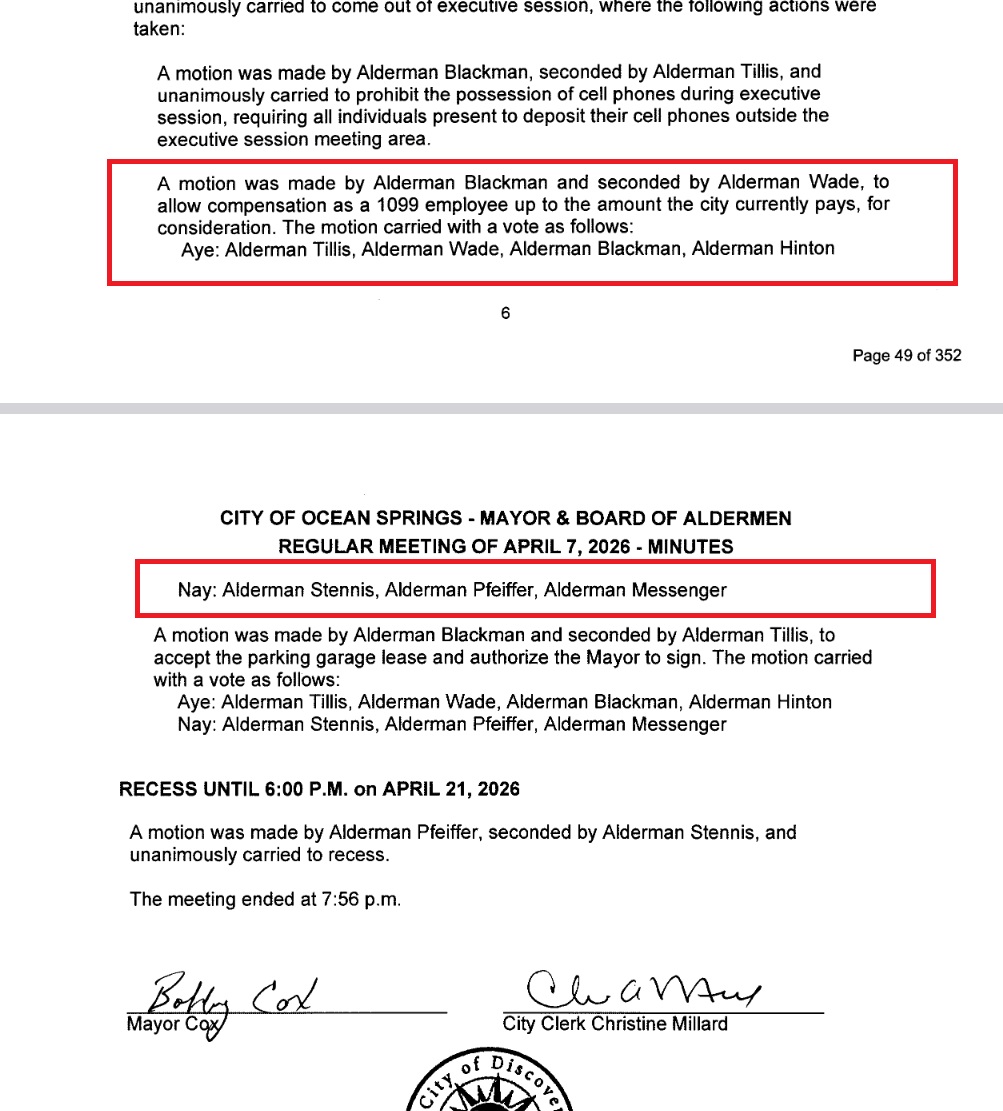
“A motion was made by Alderman Blackman and seconded by Alderman Wade, to allow compensation as a 1099 employee up to the amount the city currently pays, for consideration.”
The motion passed 4-3.
Weeks later, however, City officials are now claiming they “can find no information” that the Board of Aldermen ever took action to create such a position — despite the vote appearing in the City’s own official records.
When GC Wire submitted questions asking who had been hired, what type of 1099 arrangement had been approved, and why the matter had been handled in executive session rather than publicly, City spokesperson Laurri Garcia responded with a statement that immediately deepened the confusion.
Garcia said the City “can find no information that the Board of Alderman took any action to create such a position.”
But the Board’s own official minutes appear to say otherwise.
And according to multiple sources familiar with the executive-session action, the details behind that secret vote may prove troublesome — particularly among ordinary City employees and department heads who were never offered anything remotely similar.
What Sources Say Happened Behind Closed Doors
According to sources with knowledge of the private discussion, the vote revolved around changing a full time salaried position within City Hall into a higher paying 1099 contract position.
The employee connected to the proposed 1099 arrangement was Executive Administrator and Public Affairs Officer Laurri Garcia herself — the very same city official who later issued a statement the City could “find no information” that the Board had taken action to create such a position.
That apparent contradiction may now create even more questions about what exactly occurred behind closed doors during the April 7 executive session – and why the creation of a new contract position was not done in public.
Sources said the vote centered on a proposal that would allow Garcia to resign as a traditional city employee and immediately return under a 1099 contractor arrangement worth up to the city’s total current employment cost for her position. The proposal was presented by City Clerk Christine Millard.
Officials debated whether Garcia could transition from a salaried employee earning roughly $60,000 annually into a contractor arrangement of more than $75,000 a year – an amount that equated to the City’s current obligation when including payroll tax, retirement, and other requirements.
The proposal stemmed from complications involving Garcia’s federal retirement supplement from a previous employer and income limitations tied to her current City employment classification.
But what reportedly began as a personnel issue quickly evolved into something much larger.
Officials openly discussed restructuring compensation, redirecting payroll-related expenses into a contractor-style arrangement, and whether other city employees would eventually demand similar treatment once details of the proposal became known – topics critics may argue belonged in public session rather than executive session.
Several aldermen reportedly expressed immediate concern about both the legality and optics of the arrangement.
According to sources, some officials openly warned that ordinary city employees could become furious if they learned a high-ranking administrator was potentially being offered a customized compensation structure unavailable to everyone else.
One alderman reportedly questioned what would stop future employees from demanding the same type of arrangement.
Another warned the public optics “would be poor.”
Officials privately acknowledged that the proposal could effectively increase Garcia’s compensation without increasing the city’s overall personnel costs by redirecting money currently spent on payroll obligations and benefits into a contractor-style structure.
For ordinary city employees working under standard payroll systems, that distinction could prove significant. Under the proposal discussed behind closed doors, Garcia could potentially receive compensation approaching the city’s total employment cost for her position — including retirement contributions and payroll-related expenses that most employees never personally see reflected in their paychecks.
Mayor Bobby Cox Personally Pushed the Proposal
Sources said Mayor Bobby Cox repeatedly encouraged aldermen to support the proposal and urged the Board to “work with her.”
But the mayor’s advocacy for the proposal may now create its own political problem.
For ordinary city employees working under standard payroll structures, the proposal could appear less like a routine personnel matter and more like a customized compensation solution crafted for a high-ranking City Hall insider with close ties to the mayor.
According to sources, several aldermen acknowledged that concern during the executive session itself, openly questioning what would happen when other employees learned one administrator was potentially being offered a contractor arrangement designed to maximize her effective compensation while maintaining substantially similar duties.
City Attorney Argued the Arrangement Could Qualify as ‘Professional Services’
According to sources, City Attorney David Harris argued the proposal could potentially be treated as a professional services arrangement rather than a traditional employee relationship.
Harris advised aldermen that Garcia’s “education, training, and experience” could allow the city to classify the role under a professional services framework.
The City Attorney also reportedly told aldermen the issue would be handled on a “case-by-case basis,” suggesting the city would not necessarily be required to offer similar arrangements to all employees.
At another point in the discussion, according to sources, Harris allegedly compared the proposal to cities outsourcing services through contractors and private vendors.
But some aldermen reportedly pushed back on that comparison, arguing there is a major difference between hiring outside engineering firms or vendors and restructuring a high-ranking in-house city employee into a contractor position while maintaining substantially similar duties she currently has as a salaried employee.
Harris acknowledged many details had not yet been finalized and that the “mechanics” of the arrangement still had not been worked out.
The Board Voted Before Any Contract Existed
One of the most striking aspects of the discussion, according to sources familiar with the executive session, was that no finalized contract reportedly existed when the Board voted.
Aldermen-at-Large Matthew Hinton reportedly stated multiple times he was uncomfortable with the arrangement. He said the public would see it as a raise and Garcia would be able to use a tax professional to squeak out a lot more than her current salary.
Hinton also pushed back at Garcia’s time in the position, saying she had only been with the City less than a year. City Clerk Millard rebutted that Garcia was only now seeing the “fine print” of her federal retirement situation.
Ward 1 Alderman Steve Tillis expressed similar concerns, before he shut down the conversation, saying he was ready to vote.
Even with unresolved issues, the Board proceeded with the vote. Both Tillis and Hinton voted in favor of the new contract position, despite their previous objections. They were joined by Aldermen Kevin Wade, and Rob Blackman, who made the initial motion.
Aldermen Shannon Pfeiffer, Julie Messenger, and Karen Stennis voted no.
The ambiguity of the minutes entry describing the vote could prove significant because Mississippi municipalities generally act through clearly defined motions reflected in official minutes. Here, however, the public motion did not identify the employee involved, define the services to be performed, establish compensation terms, disclose any proposed contract, or explain exactly what authority had been granted.
The result is a public record that tells taxpayers almost nothing about what was actually approved behind closed doors.
IRS Rules May Raise Additional Questions
The proposed arrangement could also raise questions under longstanding IRS guidance governing the difference between employees and independent contractors.
Under federal tax rules, simply labeling someone a “1099 contractor” does not automatically make them an independent contractor. Regulators instead examine the actual working relationship, including who controls the work, whether the relationship is ongoing, whether the worker performs core organizational functions, and whether the employer maintains authority over how duties are performed.
That issue may become particularly significant in Ocean Springs because, according to multiple sources, the proposal allegedly involved Garcia continuing many of the same day-to-day duties she currently performs inside City Hall, but under a contractor structure instead of traditional employment.
Federal guidance has long warned that employers may face scrutiny and fines when existing employees are reclassified as contractors while continuing substantially similar duties under the same supervision and operational structure.
Whether such a structure would ultimately comply with federal worker-classification rules, state employment laws, or municipal contracting requirements remains unclear.
Questions About the Open Meetings Act
The executive session itself may now face scrutiny under Mississippi’s Open Meetings Act.
While executive sessions may be used for certain personnel matters, sources said the conversation expanded far beyond a simple employee issue and into broader debates involving contractor classification, compensation restructuring, taxpayer expenditures, payroll savings, future precedent, and potential legal exposure for the city.
The conversation drifted far beyond a routine personnel matter and into debates involving 1099 contractor structures, payroll calculations, retirement impacts, benefit costs, compensation restructuring, and the precedent such an arrangement could create for other city employees.
In the same private session, aldermen also voted for a routine policy change that would require Board members to leave their phones outside of Executive Session meetings. Critics may now question whether both actions should have occurred publicly rather than behind closed doors.
A Public Vote Nobody Can Clearly Explain
The city has still not publicly released any finalized contract or detailed explanation regarding the arrangement.
Major questions remain unanswered, including whether the Board approved a future contract, merely authorized negotiations, or simply expressed conceptual support for a possible arrangement that had not yet been fully developed.
And despite the vote appearing in the city’s official minutes, the city’s own Executive Administrator has now stated she “can find no information” that the Board ever took action to create such a position, even though multiple sources identified her as the employee connected to the proposed 1099 arrangement discussed behind closed doors.
For taxpayers — and potentially for many city employees — that may be the most troubling part of the story.
A secret vote was taken behind closed doors. The public was given only a vague sentence in the minutes. No contract has surfaced. Officials will not explain what happened.
And now the city says it cannot find evidence the action occurred at all.
(UPDATE May 14, 2026 3:45 P.M.)
Hinton: ‘No Action Has Been Taken Since’
Shortly after publication, Alderman-at-Large Matthew Hinton responded to GC Wire’s earlier questions regarding the mysterious executive-session vote.
“It was in regards to a personal matter and no action has been taken since,” Hinton wrote in a text message.
When asked about the discrepancy between that explanation and the official minutes reflecting a Board vote authorizing compensation “as a 1099 employee,” Hinton responded by sending the exact minutes entry documenting the vote.
GC Wire then replied that authorizing “compensation as a 1099 employee” appeared to constitute the creation of a contract position rather than merely discussion of a personal matter.
Hinton did not respond further.