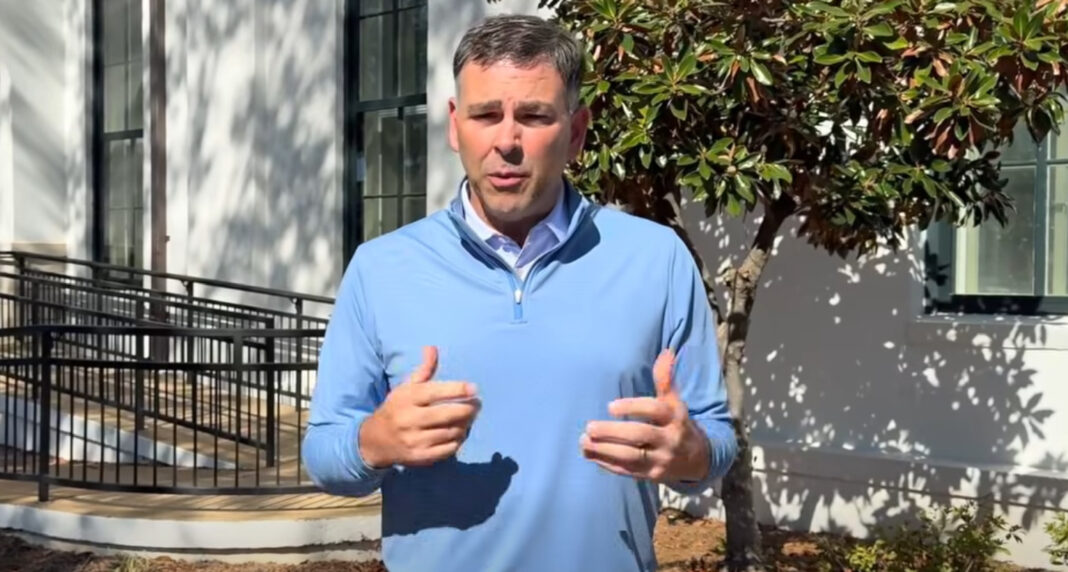
As more than 230,000 Mississippi voters were classified as inactive, GC Wire found that repeated warnings about suspicious voter mailings failed to explain that legitimate government notices also required voters’ attention.
STATE OF MISSISSIPPI (GC Wire) – As Mississippi faces a growing controversy over more than 230,000 voters classified as inactive, a GC Wire examination of public statements issued by Secretary of State Michael Watson reveals a significant omission in his repeated warnings about suspicious voter-registration mailings.
Watson repeatedly warned Mississippi residents about unofficial voter-registration letters without explaining that legitimate government notices were also being mailed to registered voters and that failing to respond could have serious consequences for their voting status.
The warnings continued after Mississippi enacted a law requiring county election commissioners to classify certain registered voters as inactive simply by mailing them address-confirmation notices.
Although Watson’s office repeatedly emphasized that mailings from private organizations were not official government correspondence, his statements did not alert residents that genuine notices were also being sent by county election commissions, explain how to recognize them, or warn that failing to respond could leave them classified as inactive.
By November 2025, the potential for confusion had become a documented problem.
Jackson County election officials publicly acknowledged that residents were mistaking legitimate voter-confirmation cards for scams. Approximately 16,000 notices were being mailed in that county alone.
The issue takes on added significance following Tuesday’s general election, when questions about inaccurate address information and inactive voter registrations became a statewide controversy.
More than 230,000 Mississippi voters were classified as inactive by Election Day, including eligible voters whose registrations were affected by inaccurate commercial address data supplied through Watson’s office.
Civil rights organizations warned the Secretary of State about those inaccuracies before the election and demanded that affected voters be restored to active status.
The controversy has focused largely on the accuracy of Mississippi’s voter rolls. But GC Wire’s examination of Watson’s public warnings raises a separate and serious question:
Did the state’s chief election official contribute to voter confusion by repeatedly warning about suspicious mailings without explaining that real government notices were also being sent and required voters’ attention?
Watson’s Repeated Warnings
Even after Mississippi enacted a law allowing election officials to classify voters as inactive simply by mailing them address-confirmation notices, Secretary of State Michael Watson continued warning residents about suspicious voter-registration mailings without explaining that official notices were also being sent and that voters needed to respond.
Watson’s office has issued warnings about unofficial voter-registration mailings since at least 2022, with advisories published in 2022, 2023, 2024, 2025, and 2026.
On August 18, 2025, Watson’s office warned residents about mailings distributed by the Voter Participation Center, a private organization that sends voter-registration materials to prospective voters.
“This is not official correspondence from the Mississippi Secretary of State’s Office or county Circuit Clerks and is not an indication of a change in anyone’s voter registration status,” the statement said.
The office encouraged residents to verify their registration through YallVote.ms or their county circuit clerk.
On July 2, 2026, Watson’s office issued another warning, advising residents to exercise caution with QR codes and links contained in voter-registration verification mailings from private entities.
“This office cannot verify whether or not links or QR codes distributed by private entities are accurate or safe, and we always advise caution before scanning a link from an unknown source,” the statement said.
The office again directed voters to trusted election officials to verify their registration information. Neither warning explained that county election commissions were also sending legitimate address-confirmation notices that voters needed to take seriously. Neither explained how to distinguish those notices from the unofficial mailings Watson was warning about.
And neither explained that voters who failed to respond could remain classified as inactive, requiring them to cast affidavit ballots instead of regular ballots.
The distinction was particularly important because Mississippi law does not require proof that a voter received an official confirmation notice before the inactive classification occurs.
Residents Mistook Official Notices for Scams
The potential for confusion became a documented problem in Jackson County in November 2025.
WLOX reported that the Jackson County Election Commission was mailing approximately 16,000 address-confirmation cards to registered voters.
The notices were legitimate government correspondence requesting confirmation of voters’ residential addresses. But election officials were receiving calls from residents who believed the cards were scams.
Jackson County Election Commission Chairman Danny Glaskox confirmed the confusion in an interview with WLOX.
“These are officially coming from us. If you have questions, you can call us anytime you want to, and we’ll verify it is from us,” Glaskox told the station.
The list of recipients came from the Secretary of State’s Office and identified voters who may have moved from their registered addresses.
Glaskox emphasized the importance of completing and returning the cards, explaining that voters who remained classified as inactive would be required to cast affidavit ballots when they appeared at the polls.
The report established that legitimate government correspondence was being mistaken for potentially fraudulent mailings.
Watson’s warnings were not mentioned as possible reason for confusion. Nevertheless, the circumstances illustrate the distinction missing from the Secretary of State’s public advisories: some voter-registration mailings are unofficial solicitations, while others are legitimate government notices connected to changes in registration status.
A Law That Changes Voting Status When a Notice Is Mailed
House Bill 1310, signed by Governor Tate Reeves on April 19, 2023, took effect January 1, 2024, and established Mississippi Code § 23-15-152.
The law created procedures for identifying potentially outdated voter registrations, sending address-confirmation notices, and eventually removing certain voters from the rolls.
Confirmation notices can be triggered by information suggesting that a registered voter has moved or by certain periods of voter inactivity. But the most consequential provision concerns when a voter is classified as inactive.
Under subsection (3), county election commissioners are required to place registered voters on inactive status when they are sent confirmation notices.
The statute states:
“The county election commissioners shall place any registered voter who has been sent a confirmation notice on inactive status in the Statewide Elections Management System.”
The law does not require proof that a voter received the notice before the inactive classification occurs. It also does not require proof that the voter moved or otherwise became ineligible. A voter can remain at the same address and retain legal eligibility while being classified as inactive under the state’s registration-maintenance procedures.
That classification has consequences.
Mississippi law requires inactive voters to cast affidavit ballots rather than regular ballots unless their active status has been restored. Those ballots are subsequently reviewed to determine whether they qualify to be counted.
The law also establishes procedures through which voters who fail to respond or participate during the applicable period spanning two federal general elections may eventually be removed from the rolls. For voters who never received a confirmation notice, or who discarded one believing it was suspicious correspondence, the consequences may not become apparent until they attempt to vote.
Mississippi’s law goes further than the federal National Voter Registration Act, which establishes procedures for confirming addresses and safeguards against removing eligible voters.
Mississippi requires voters to be classified as inactive as soon as confirmation notices are mailed, forcing them to cast affidavit ballots unless their active status is restored.
Other states take a different approach. In Georgia, inactive voters can still cast regular ballots, while Florida generally allows voters 30 days to respond to a final confirmation notice before classifying them as inactive.
Inaccurate Address Data Complicated the Process
The controversy surrounding inactive voters expanded during the November 3, 2026, election.
In a November 6 investigation, Mississippi Today reporter Madeline Nguyen revealed that Watson’s office had entered into a $50,000 agreement with credit-reporting company Experian in 2024 to obtain commercial address information for voter-roll maintenance.
The information was supplied to county election officials to identify voters who might have changed addresses.
But the data contained inaccuracies.
According to Mississippi Today’s reporting, eligible voters were classified as inactive based on address information that had not been adequately verified. The investigation identified voters who were incorrectly listed as living at addresses where they had never resided or had not lived for years.
One voter, Thomas Minor of Itawamba County, was incorrectly identified as residing approximately 160 miles away in a Delta community he had never visited.
Another, Heather Williams, was linked to an address where she had not lived in years.
The errors raised concerns about the reliability of the information being used to trigger official confirmation notices.
If a voter was incorrectly identified as having moved, an official notice could be generated even though the person remained at the registered address. And if the notice was sent to an incorrect address, the voter might never receive it.
That problem is distinct from voters mistaking legitimate correspondence for scams, but both involve a registration-maintenance process dependent on mailed notices and accurate information.
Watson Was Warned Before the Election
According to Mississippi Today’s investigation, a coalition of civil rights organizations warned Watson about the Experian-related problems four days before the November 3 election.
The coalition, which included the NAACP Legal Defense Fund, ACLU of Mississippi, and Southern Poverty Law Center, demanded that eligible voters incorrectly classified as inactive be restored to active status.
“The voters on this list did nothing wrong,” the organizations wrote.
The coalition also requested instructions to ensure that inactive voters would be permitted to cast affidavit ballots, as Mississippi law requires.
Mississippi Today reported that Watson did not respond to the coalition’s demands.
Assistant Secretary of State Liz Jonson acknowledged receiving the correspondence but cited restrictions on voter-roll maintenance during the period immediately preceding a federal election.
“Per state law, the Statewide Election Management System (SEMS) is currently in a blackout period thus no systemic voter roll maintenance is allowed,” Jonson wrote.
Mississippi Today noted that the statutory restrictions prohibit certain inactivations and removals within 90 days of a federal election but do not impose the same restriction on restoring voters to active status.
The Secretary of State’s Office did not implement the requested statewide reinstatements.
The investigation also documented concerns from local election officials who encountered problems with the Experian data.
Lee County Election Commissioner Jamie Gunnells reported widespread confusion among voters who discovered they had been classified as inactive. He described some voters leaving polling places without completing the affidavit-ballot process.
When Gunnells publicly raised concerns about the data, Watson responded on Facebook by emphasizing the responsibility of county election commissioners to verify information before acting upon it.
“Ultimately, no matter what data is sent to the election commissioners, you should understand your job is to verify the information before acting upon it,” Watson wrote.
“That said, our goal is to send you the best information available, and we did so.”
Gunnells questioned how county election officials were expected to verify the commercial data supplied by the state.
Meanwhile, in an interview with the Magnolia Tribune, Watson acknowledged the possibility that some information was inaccurate.
“Was some of the data off? Perhaps,” Watson said.
By Election Day, more than 230,000 Mississippi voters were classified as inactive. That figure includes voters placed on inactive status for multiple reasons and does not establish that all were improperly classified. However, the investigation documented cases involving eligible voters whose registration status had been affected by unreliable address information.
The number of otherwise eligible voters who ultimately failed to cast ballots because of inactive classifications has not been established.
The Risk of Being Removed Entirely
The consequences of an inactive classification can extend beyond a single election.
Under Mississippi’s voter-roll maintenance law, registered voters who do not respond to confirmation notices, update their information, or vote during the applicable period spanning two federal general elections may eventually be removed from the statewide voter-registration system.
Investigations reported that some voters first classified as inactive through Experian-related address information in 2024 could now face removal following the 2026 election.
Those voters would need to register again before participating in future elections.
The Secretary of State’s Office has since stopped supplying Experian data to counties for voter-roll maintenance.
According to Mississippi Today, the office has moved to another commercial data provider, IDI Data, which aggregates information from multiple sources, including credit bureaus and government records.
The change raises further questions about how the state verifies commercial address information before using it to initiate actions that can affect voter registrations.
Questions About Watson’s Public Warnings
The controversy over Mississippi’s inactive voter registrations has focused largely on inaccurate address data, affidavit ballots, and the possibility that eligible voters could eventually be removed from the rolls.
But GC Wire’s examination of Watson’s public warnings reveals a separate issue that predates the November 2026 election.
For years, his office warned residents about unofficial voter-registration mailings.
After Mississippi enacted its new voter-roll maintenance law, those warnings continued without an accompanying explanation that county election commissions were sending legitimate notices requiring voters’ attention.
By November 2025, Jackson County election officials were publicly acknowledging that residents were mistaking genuine notices for scams.
A year later, Mississippi’s voter-roll maintenance system was under scrutiny following reports that inaccurate commercial address information had contributed to eligible voters being classified as inactive.
The available reporting does not establish how many voters discarded legitimate notices because they believed the mailings were fraudulent or whether Watson’s warnings influenced those decisions.
But the documented confusion raises an important question about the adequacy of the Secretary of State’s public communications.
Why did Watson repeatedly warn Mississippi voters about suspicious registration mailings without also telling them that real government notices were also being mailed, how to recognize those notices, and why responding mattered?
The distinction could have been explained alongside the warnings about third-party correspondence.
Instead, residents received repeated advisories about unofficial mailings while county election commissions were sending legitimate notices connected to a process that could change their voting status.
For voters who discarded an official notice believing it was another suspicious mailing, the misunderstanding could leave them classified as inactive.
And for those who discovered that classification only when they arrived at the polls, the consequences could extend well beyond an unanswered letter.