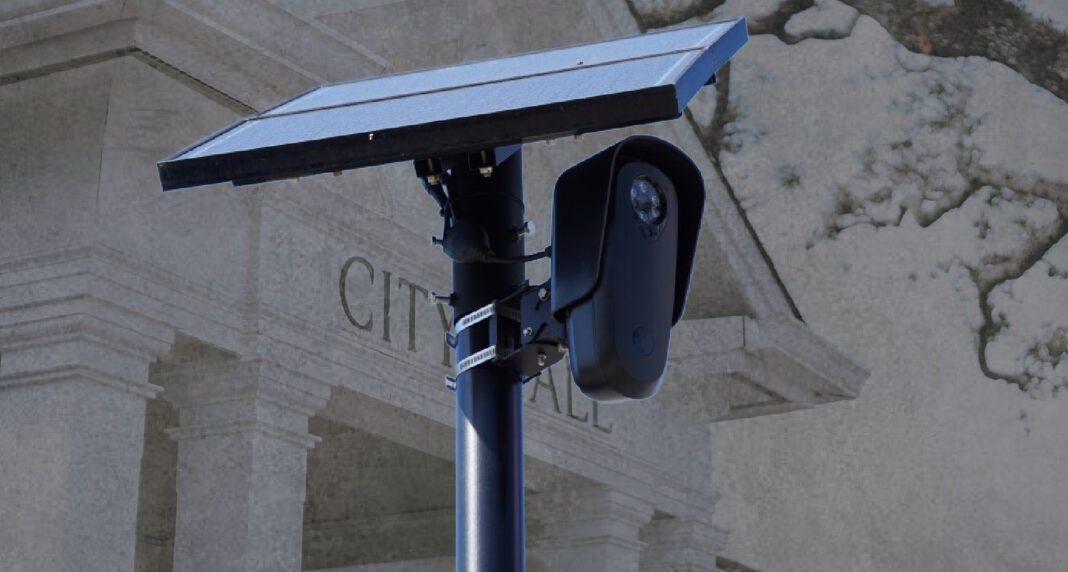
Nearly two years after this reporter sounded the alarm on Flock Safety cameras in Ocean Springs, multiple bills in Washington seek to defund cities that deploy the license plate reading technology.
In December of 2024, this reporter partnered with the Ocean Springs Record to publish an expose documenting how the Board of Aldermen quietly approved the purchase of an AI-powered operating system capable of tracking, recording, searching, and sharing information about people and vehicles traveling through certain parts of town.
City officials responded swiftly. The same day the article was published, former Ocean Springs Police Chief Ryan LeMaire publicly branded the article as “100 percent false,” confidently telling residents the Flock system he purchased on the city’s behalf did not have any of the capabilities described in the piece.
He lied.
Internal documents later published by The Record revealed the technological scope stated in article matched the contract the city had entered with Flock, as well as the accompanying training materials.
Since sounding the alarm locally, cities across the country have been rethinking, and often canceling, their contracts with the controversial Atlanta based Flock Safety.
Now, lawmakers on Capitol Hill are attempting to penalize cities that install the invasive camera systems in their municipalities.
A Pair of De-Flocking Bills
The legislative push is led by the Protection Against Mass Surveillance Act, introduced by Representative Tim Burchett (R-TN).
This bill directly attacks the financial pipeline used by local governments to acquire these systems by explicitly banning state and local municipalities from spending federal funds to purchase or maintain Flock cameras.
The legislation would also bar federal law enforcement and intelligence agencies from purchasing or accessing data from these private surveillance databases.
In tandem, Representative Thomas Massie (R-KY) has introduced a separate, more aggressive defunding measure designed to penalize non-compliant cities.
Rather than just blocking surveillance-specific grants, Massie’s bill leverages wider federal funding streams that include Department of Justice (DOJ), Department of Homeland Security (DHS), and federal highway safety grants.
Under this framework, any municipality or local police department that actively deploys Flock cameras or similar mass-surveillance networks would see these vital federal funding channels completely withheld until the technology is removed.
Together, proponents argue these Washington efforts reflect a growing bipartisan alarm over the lack of warrants, guardrails, and constitutional compliance within the private surveillance industry.
In addition to logging plate numbers, Flock technology retains other vehicle information, including dents, roof racks, bumper stickers, and similar identifiers. Lawmakers backing the bills argue that Flock’s ability to create a digital “vehicle fingerprint,” amounts to an unconstitutional, automated dragnet of ordinary citizens.
By threatening a city’s federal purse strings, Washington is attempting to force local officials to choose between maintaining their lucrative federal grants or continuing their contracts with the Atlanta based surveillance firm.
Flock on the Rise
Ocean Springs is far from an isolated incident; rather, it served as an early indicator of a massive surveillance web quietly expanding across the state’s southern counties.
Over the last few years, this local trend exploded into a national phenomenon, with Flock Safety embedding its automated license plate readers in over 5,000 cities across the United States. Police departments nationwide pitched the AI-powered network to local city councils as an indispensable, interconnected database.
However, this rapid proliferation has effectively turned neighborhood streets into a massive digital dragnet, mapping more than 122,000 cameras across the country and logging the daily travel histories of millions of law-abiding Americans without their consent.
Yet, the tide has aggressively turned over the last few months as a wave of public outrage over civil liberties and government overreach has sparked an unprecedented national backlash.
In communities where local officials have been slow to respond to these privacy anxieties, frustrated citizens have even taken matters into their own hands, actively obscuring, painting over, or physically dismantling cameras to stop the recording of their neighborhoods.
This immense public pressure has forced a rapid wave of official contract cancellations, with dozens of jurisdictions in over 20 states voting to pull the plug, reject, or deactivate their systems.
The most devastating blow to the company came when the Los Angeles Police Department, the third-largest police force in the country, officially allowed its contract with Flock to expire. The LAPD cited severe civil liberties concerns and an internal audit exposing a staggering 32% false-positive rate on stolen vehicle alerts.
Taking a Stand in Your Community
The battle over mass surveillance may be playing out in the halls of Congress, but the ultimate decision to deploy or dismantle these digital dragnets is made right in your local city hall.
Whether you are walking the streets of Ocean Springs or reading this from any other municipality in America, the cameras operating in your neighborhood exist because local elected officials authorized tax dollars to put them there.
Because these multi-year contracts with Flock Safety frequently come up for renewal or expansion, residents possess immense leverage to demand transparency and force a reversal of local surveillance policies.
The most effective step is to inject these concerns directly into the local political record.
Residents can take immediate action by signing up for the public comment portion of the next Board of Aldermen or city council meeting to voice their opposition directly to decision-makers.
Beyond showing up to speak, citizens can gather their neighbors to launch petitions, coordinate call-in days to the mayor’s office, and file formal public records requests to uncover the hidden financial costs and data-sharing agreements behind these contracts.
Local leaders remain highly sensitive to concentrated voter pressure, especially when lucrative multi-year surveillance contracts threaten to become major liabilities during upcoming election cycles.
By showing up, asking sharp questions, and demanding strict financial and constitutional accountability, ordinary citizens have already forced major police departments across the country to pull the plug on these digital watch networks.
Your town could very well be next, but only if its residents take a stand.