
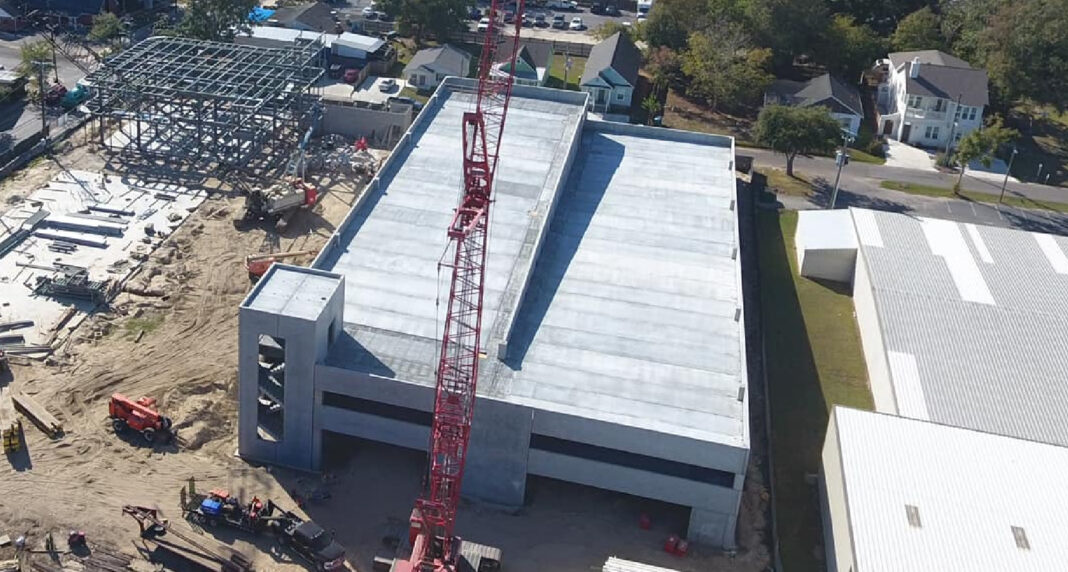
OCEAN SPRINGS, MS (GC Wire) – The City of Ocean Springs says it has no records of a competitive bidding process for construction of the downtown parking garage — a mandatory condition of the $8 million grant used to build it. As a result, taxpayers could be on the hook for repaying millions for a parking garage the City says it does not own.
Rather than accepting bids, the City’s private partner hired its sister company to handle construction — a company that shares the same principal leadership and overlapping ownership.
Under the terms of the funding, the agreement attaches a significant penalty to the bidding requirement. If the parties fail to satisfy this commitment, they are contractually obligated to “repay the State any expended grant funds.”
The Board of Aldermen approved those terms in May 2022 and the City executed agreements containing the mandatory bidding clause a few months later.
Now, the City could be required to repay those millions — even though it does not own the garage built with the grant funds.
How the Project Was Supposed to Work
The downtown parking garage at 1515 Government Street was funded through two grants awarded under the Mississippi Gulf Coast Restoration Fund (GCRF) program — $2 million in Phase I funding and $6 million in Phase II. The grants were facilitated by the Mississippi Development Authority (MDA).
The City applied for the funding alongside its private development partner, OHOS Development, LLC, as part of a larger mixed-use project that included a hotel and retail space.
As a condition of receiving public money, Ocean Springs and its partner were required to meet specific performance metrics in order to receive and retain the funding. One of those requirements was straightforward:
The construction of the project had to be “bid out.”
In plain terms, that means opening a publicly funded project to competition for the construction work.
It’s not just a formality. The bidding process is designed to ensure transparency, competition, and responsible use of public funds.
State rules governing GCRF grants reinforce that requirement:
“All contracts and purchases must be made in accordance with normal bid and purchase laws of a local unit of government or other public entity if the grant is for a public purpose.”
To verify whether that process occurred, GC Wire made a public records request to City officials seeking any documents demonstrating compliance with the requirement that the project be “bid out.”
The City’s response:
“The City of Ocean Springs has no responsive document regarding your public records [request].”
Yet the condition was accepted by all parties as part of the grant.
So, Who Built It?
The grant agreements with MDA were signed in August 2022 by former Mayor Kenny Holloway on behalf of Ocean Springs and John Oropesa on behalf of OHOS Development, the City’s private partner in the project.
In those agreements, Oropesa is identified as the managing member of OHOS.
OHOS was responsible for developing the parking garage as part of the larger mixed-use project. The construction work, however, was carried out by Orocon Construction LLC.
According to Oropesa’s LinkedIn profile, he is also the owner and president of Orocon. Secretary of State filings and the Orocon website confirm the relationship.
That places both the development entity and the construction company under the same leadership.
How the Money Moved
Under the structure of the grant, construction costs were not paid directly by the State.
Instead, the private development entity — OHOS Development — paid for the construction and was then reimbursed with grant funds.
In this case, OHOS hired Orocon Construction to perform the work.
Both companies are led by the same individual.
That means the entity receiving reimbursement for the project paid those funds to a company under the same leadership.
Without a documented bidding process, there is no public record showing how that arrangement was established, whether other contractors were considered, or whether the costs were tested through competition.
Why That Matters
The grant agreement — and state rules — required the project to be “bid out,” a process intended to open publicly funded work to competition and document how a contractor is selected.
In a typical competitive process, the developer and the builder are connected through that documented selection — whether through formal bids, proposals, or evaluations.
Here, the development entity and the construction company are run by the same person.
Without records of a bidding process, there is no public documentation showing:
- how the builder was selected
- whether other contractors were considered
- or whether any competing proposals were submitted
Public social media posts from companies involved in the project show that subcontractors were brought in to perform portions of the work under Orocon Construction.
Those posts identify Orocon as the lead contractor and describe other companies as part of the construction team.
Subcontracting portions of the work, however, is not the same as competitively bidding the project itself. The requirement in the grant agreement applies to how the primary contractor is selected — not how that contractor later hires subcontractors.
As of publication, OHOS has not responded to questions related to how Orocon was chosen.
A Separate Risk in the Lease
After construction, the project was also used to secure private financing. OHOS placed mortgage liens on the structure.
The proposed lease agreement, written by City Attorney David Harris and approved by aldermen earlier this month, includes a subordination clause, placing those liens ahead of the City’s interest.
In practical terms, that means the lender’s rights take priority over the City’s lease.
If the developer were to default on those loans, the lender could foreclose on the property — potentially causing the City to lose access to the garage.
What’s at Stake
The agreement required the project to be bid out.
It also set a consequence:
If that requirement was not satisfied, the City and its development partner “shall repay the State any expended grant funds.”
The City says it has no records showing the project was ever bid.
The same individual who signed the agreement on behalf of the developer is also owner of the company that built the project.
The project itself was funded through reimbursement to that same development entity. And the structure is now tied to private debt, with the City’s interest subordinated to those liens.
Those facts leave a narrow set of possibilities.
Either the required bidding process occurred and no record of it exists — or it never occurred at all.
If it didn’t, the agreement spells out the consequence.



SMH…… Sometimes I just have no words, this is one of them….. How can you bid out a project since that was a requirement, and not retain those bids?? Something is afoot here!