
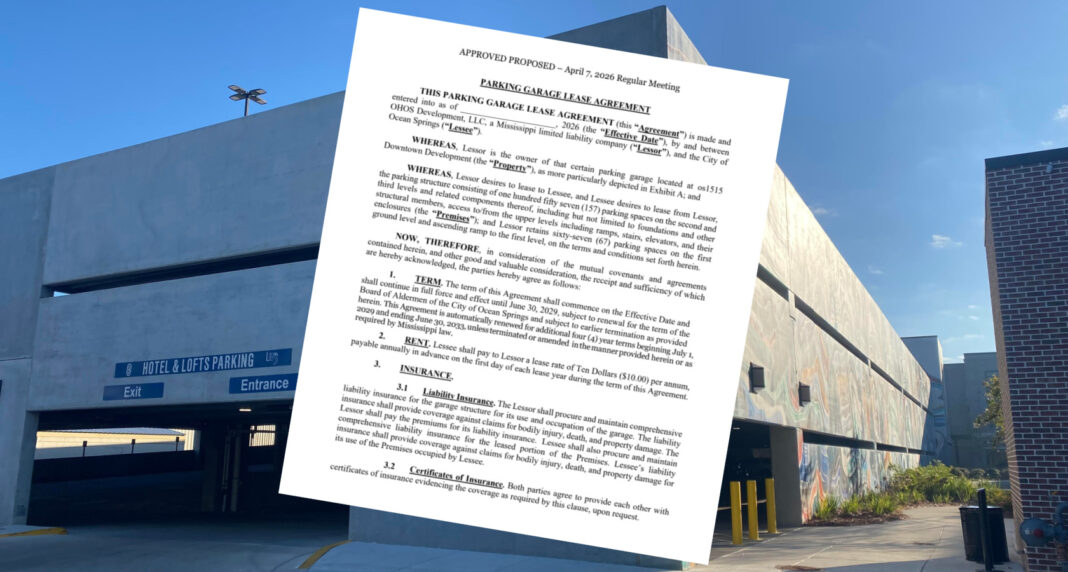
OCEAN SPRINGS, MS – Last Friday, GC Wire obtained a copy of the controversial downtown parking garage lease and sent it to three Ocean Springs aldermen. Each had the same reaction: “How did you get that?”
Just three days earlier, before their April 7 vote, those same aldermen were shown the lease under strict conditions. The document was stamped “CONFIDENTIAL” in red, and City Attorney David Harris told them they were not allowed to leave the room with a copy.
No copy meant no outside legal review. No copy meant no way to compare what they approved to what was actually signed. And no copy meant no asking constituents what they think before approving.
In effect, elected officials were asked to vote on a binding agreement they could not independently examine.
But a city attorney slapping a “confidential” label on a public document does not make it so.
That same secret document aldermen were not allowed to leave with is now available for anyone to download on this page.
Why the Lease Was Never Confidential
So, how did GC Wire obtain a copy of a document the city attorney refused to hand over to elected officials?
Simple. We asserted our rights – something every aldermen also had the opportunity to do during that April 7 meeting.
Under Mississippi law, any document “prepared, possessed, or retained” by a public body in connection with official business is a public record. That includes contracts, drafts of contracts, and documents presented to elected officials for consideration.
There is no exception in the law that allows a city attorney to label a contract “confidential” simply because it is under review or could cause political backlash. If the document was used by the Board of Aldermen to make a decision, it was subject to public disclosure.
And this wasn’t just any document.
This was a binding lease agreement involving public funds and long-term financial obligations for the City of Ocean Springs. By definition, it is exactly the type of record the law is designed to keep open to public inspection.
Yet City Attorney Harris instructed aldermen they could not take a copy with them.
That directive did more than limit transparency to the public. It restricted the ability of elected officials to do their jobs.
Without a copy, aldermen could not seek independent legal advice. They could not verify whether the final executed agreement matched what they were shown. They could not meaningfully scrutinize the terms of a deal they were being asked to approve that same night.
“We are supposed to trust the legal guidance,” Ward 4 Alderman Shannon Pfeiffer told GC Wire. “It’s time we all brush up on the Public Records Act, because we can no longer trust what is being said to us behind closed doors.”
Ward 1 Alderman Steve Tillis could not confirm the document sent to him was the same one the Board voted on in executive session.
“We weren’t allowed to take a copy, so I can’t tell you if that is the same lease,” he said, confirming the restriction left aldermen unable to verify whether a final executed document would match what they approved.
In practical terms, they were asked to vote first and do their due diligence later, if at all.
That is not how public governance is supposed to work.
Harris’s claim of confidentiality weakens even further when paired with the fact he had already sent a copy of the lease to third parties.
Why the Lease is Controversial
The downtown parking garage was built with public funds acquired through two Gulf Coast Restoration Fund grants – $8,000,000 in total.
The grant applications, submitted jointly by Ocean Springs and OHOS Development LLC, told state authorities the garage ownership would be owned to the city once construction was completed.
That never happened.
Instead, OHOS used the garage as collateral to secure a series of bank loans. And city officials say they are now alright with OHOS retaining ownership of the $8 million structure – with the city leasing the garage and paying all associated costs.
On April 7, the Board of Aldermen voted to accept the terms of a lease agreement critics say does not protect the city.
Subordination Clause: Who Really Comes First
Buried in the lease is a provision that flips the entire deal on its head.
Section 14 states:
“This Lease Agreement is and shall be subordinate to any mortgages or deeds of trust now or hereafter placed upon the leased Premises…”
In plain English, that means any lender OHOS used to obtain loans takes priority over the city.
If the project runs into financial trouble and the property goes into foreclosure, the lender — not the city — controls what happens next.
That could mean:
- Terminating the lease
- Selling the property to a third party
- Repurposing the structure
- Restricting or eliminating public access
And that’s where this becomes more than just a bad clause.
The parking garage was built with $8 million in GCRF grant money, awarded based on representations that it would serve a public purpose.
If foreclosure wipes out that access, it raises a serious question: Does the State come back and demand its money?
Because under Mississippi Development Authority grant agreements, failure to meet public-purpose commitments can trigger repayment obligations. In other words, a private foreclosure event could expose taxpayers to an $8 million clawback.
There are standard ways to protect against exactly this scenario. The city could have demanded a non-disturbance clause, ensuring the city’s lease survives foreclosure.
Instead, it does the opposite, affirmatively subordinates the City’s interest to any present or future lender.
There is also nothing in the lease preventing OHOS from selling the property.
There is no right of first refusal. There is no approval requirement for a transfer of ownership. There are no safeguards ensuring a new owner honors the same public commitments.
Who’s the Boss?
The issue isn’t just what’s in the lease. It’s how it was pushed through.
A document tied to $8 million in public money was labeled “confidential,” withheld from elected officials, and approved without independent review – all in a single night.
No copy.
No second opinion.
No safeguards.
And now, buried in that agreement are provisions that put lenders ahead of the city and taxpayers on the hook if things go wrong.
That’s not how public business is supposed to be done.
But it’s exactly what happened.
The Board approved the lease 4-3, with Aldermen Shannon Pfeiffer, Julie Messenger, and Karen Stennis voting nay. Rob Blackman, Kevin Wade, Matthew Hinton, and Steve Tillis voted to approve.
Click here to see or download your copy of the “confidential” lease.

I just don’t see how public money can be granted to a city as a ruse for a private entity to own a garage. City ownership must occur. Why isn’t the State stepping in NOW to straighten this out before it gets worse by the city leasing what it should be owning? SMH