
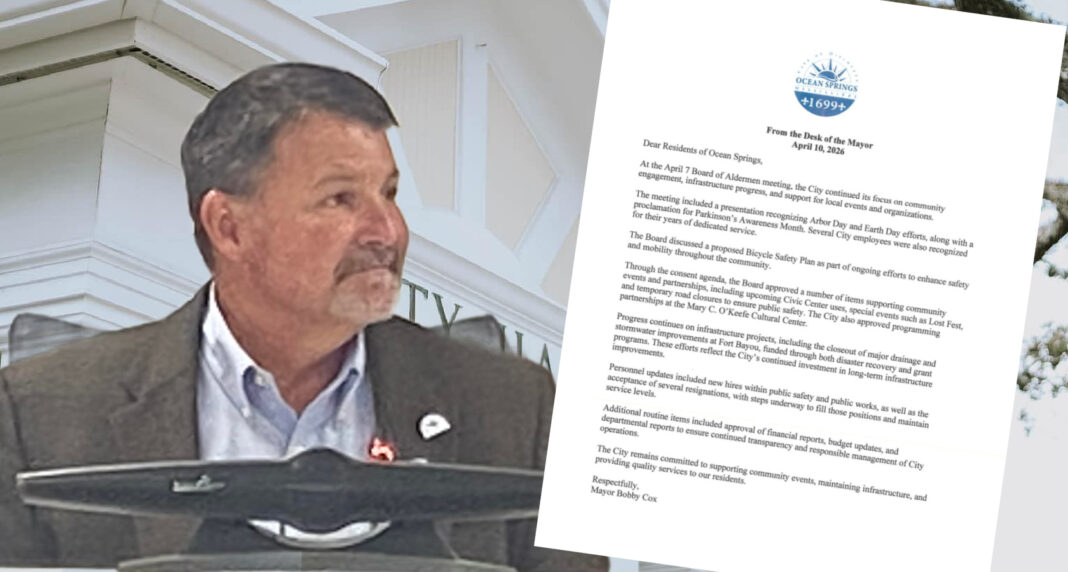
OCEAN SPRINGS, MS (GC Wire) — Three days after a contentious Board of Aldermen meeting, Mayor Bobby Cox released a public summary touting the city’s “continued transparency.” But the letter ironically leaves out the Board’s most consequential actions of the night.
Dated April 10, the mayor’s summary highlights routine agenda items — Earth Day proclamations, infrastructure updates, event approvals, and even some unattributed resignations — but does not mention the downtown parking garage, one of the most closely watched and debated issues in the city.
Also absent are multiple decisions made behind closed doors, including the creation of a contract position and a policy change affecting aldermen. Both actions were taken in a private executive session, despite involving matters that typically require public deliberation and a public vote under state law.
A Workshop… Then a Vote
During the public portion of the April 7 meeting, aldermen spent a substantial portion of time debating the status of the parking garage at 1515 Government Street. Questions centered on whether the city was legally required to enter into a lease and whether it should already own the structure outright.
Those concerns led to a unanimous vote to hold an April 15 workshop to review the documents in detail and potentially bring in outside counsel for an independent opinion. But moments later, the Board learned that a finalized version of a lease agreement had already been sent to the developer.
Shortly after entering executive session, the Board voted 4–3 to approve that same lease — without returning to open session for further debate.
The parking garage has been the subject of sustained public scrutiny for several years, yet neither of the garage related actions taken were mentioned in the mayor’s summary of the meeting.
Decisions Behind Closed Doors
Also absent from the mayor’s letter were two additional actions taken in executive session.
The Board voted to prohibit aldermen from bringing cell phones into executive session — a procedural rule adopted outside of public view.
In the same closed-door session, aldermen approved the creation of a new city contract position. No public discussion of the change occurred prior to the vote, and no details beyond the final tally were provided when the Board returned to open session.
All fifty states have “sunshine laws,” which mandate governments to conduct most business in public view, rather than behind closed doors. In Mississippi, those laws fall under the Open Meetings Act, a series of statutes that regulate local bodies, such as the Board of Aldermen.
The Act allows for a precise number of issues to be discussed in private. Ocean Springs often expands that list to include issues meant to be heard by the public. Last Tuesday’s Board meeting was no exception.
What the Public was Told
After leaving public view on Tuesday, the City Clerk returned to announce the topics of the private meeting, an action required by state law. The clerk announced:
“We have a motion to stay in executive session for two personnel matters, transactions regarding security plans and devices, and the parking garage.”
The laws are specific. If the public is going to be shut out, the city is required to explain in detail why they are not allowed to hear discussions, debates, and possible actions taken by vote. While personnel issues are one of the few reasons to meet privately, the other two reasons given were broad and inconsistent with state law.
Dr. Jason Camp of the Mississippi State University Extension Center for Government and Community Development published a document to assist municipalities in navigating these very issues.
“The body must state in open session the reason for going into executive session, and the total vote must be recorded in the minutes of the meeting,” he wrote. “The reason for entering executive session must be specific.”
Merely stating “parking garage” does not cut it.
Board members remained in private session for approximately 90 minutes. When they returned, the clerk announced the actions taken behind closed doors:
“I have three motions to read. The first one is a motion to prohibit the possession of cell phones during executive session, and all present must deposit cell phones outside the place of the executive session. Motion by Alderman Blackman, seconded by Tillis, and unanimous approval. The second one, motion by Alderman Blackman to allow compensation as a 1099 employee up to an amount city currently pays for consideration. Seconded by Alderman Wade passed four to three. The ayes were Tillis, Wade, Blackman, Hinton. Nays were Stennis, Pfeiffer and Messenger. And the third one, a motion to accept the parking garage lease and authorize the mayor to sign. Motion made by Alderman Blackman, seconded by Alderman Tillis. Passed four to three with the ayes Alderman Tillis, Alderman Wade, Alderman Blackman, and Alderman Hinton. Nays were Aldermen Stennis, Pfeiffer, and Messenger.”
Let’s break that announcement down and compare the issues with the law.
Banning Cell Phones
Aldermen are well within their rights to make a general policy barring cell phones from executive session meetings, but they are not permitted to make such policy changes in private. The Board used the description of “transactions related to security plans and devices” as their reason to hide this vote from public eyes.
The law does allow for executive sessions regarding “security personnel, plans or devices,” but this exemption is narrowly interpreted to protect sensitive information that, if public, would compromise safety – like blueprints of a vault or police deployment tactics.
Critics argue a general policy determining whether aldermen are allowed to carry cell phones into closed sessions would not fit the criteria used to justify hiding the topic from public scrutiny.
1099 Employee
The city appears to have transformed a payroll staff position into a 1099 contract position. While discussion of this employee’s personal situation may be allowed in private by the Open Meetings Act, the action of creating a contract position is not.
In 2002, the Attorney General opined on this very matter, stating, “There is no authority for the Board to enter into executive session to discuss the employment of an individual as an independent contractor.”
The law gives specific reasons allowed to take a personnel issue behind closed doors:
“Transaction of business and discussion of personnel matters relating to the job performance, character, professional competence, or physical or mental health of a person holding a specific position, or matters relating to the terms of any potential or current employment or services agreement with any physicians or other employees of public hospitals, including any discussion of any person applying for medical staff privileges or membership with a public hospital.”
According to the statute and the Attorney General, converting a staff position from regular payroll to a 1099 contract position does not appear to fit that description.
The Parking Garage
This is the big one. The downtown parking garage has been the topic of public debate for quite some time. Eight million dollars in public money was used to fund the structure – a pot of money acquired by a grant application that specifically stated the garage would belong to the taxpayers. But now, city officials contend that the garage belongs to a private company and the city must lease it from them.
This topic has been discussed and voted on many times since 2019. Each of those debates and actions took place in public view. Even as recently as October 2025, a lease agreement was up for discussion by the Board and done so in public.
But last week, the Board made the public think the issue would be discussed in a public workshop scheduled for April 15, only to move to a private session and approve a lease that had already been sent to the owners.
State law allows private discussions when the topic is “transaction of business and discussion regarding the prospective purchase, sale or leasing of lands,” but they must inform the public that is the reason for moving the issue into executive session. In this case, the clerk stated the topic was simply “the parking garage.”
And cities are not required to discuss real estate topics in private. They can choose to allow the public to listen or even participate. That has been the case with the parking garage for nearly seven years, until now – even though the issue has proven to be of great concern to the public.
Regardless of how the meeting took place, a lease agreement approved for execution by the Board should be made available to the public. GC Wire has yet to receive the document requested via public records request.
City of Secrets
Mayor Cox’s letter closes by reaffirming the city’s commitment to “continued transparency.” But the most consequential decisions of the April 7 meeting — including a divided vote on a major public contract and multiple other actions taken in executive session — were left out of that public account.
For residents, transparency isn’t measured by what is included in a summary — it’s defined by what the public is allowed to see, hear, and question as decisions are being made.
Mississippi law gives citizens a role in that process. When public business is conducted behind closed doors or outside the scope of the law, residents can file a complaint with the Mississippi Ethics Commission, the agency tasked with enforcing the Open Meetings Act.
Last week, Ethics Executive Director Tom Hood handed down a harsh warning to the city for an attempt to keep the public from witnessing scheduled aldermen meetings with a state legislator. And last month, a local journalist told GC Wire she was chastised by the mayor’s office for sharing a report on the city’s failing infrastructure – being told the public was “not ready to see or understand what is in that report.”
Ocean Springs calls itself the “City of Discovery.” For many residents following the issues, the question now is what they’re being left to discover on their own.


I would like to know this “company” that owns the parking garage. As a lifelong resident of Ocean Springs, I feel the people of the town deserve to know.
Thank-you
Tell me how this is legal if required by statue?
“Eight million dollars in public money was used to fund the structure – a pot of money acquired by a grant application that specifically stated the garage would belong to the taxpayers. But now, city officials contend that the garage belongs to a private company and the city must lease it from them.”
🙂
I’m a little confused, was it public money that built the garage or did someone get a grant to build the garage and now the city must pay to lease it?