
OPINION EDITORIAL by GC Wire Publisher E. Brian Rose
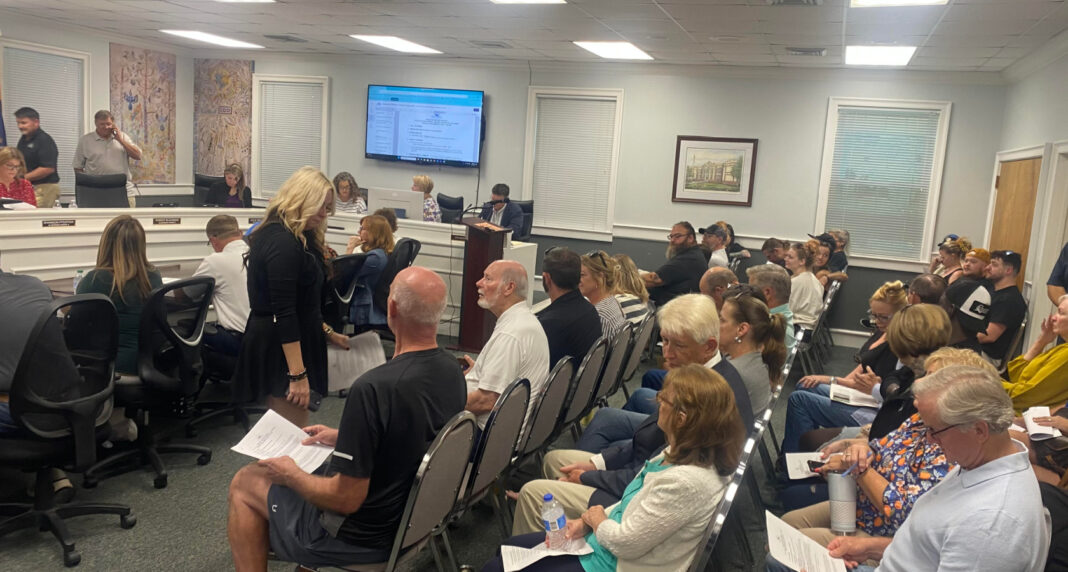
Tonight, Ocean Springs City Hall is expected to be standing room only.
Residents opposed to the proposed 123-unit Holly Grove townhome development on Pabst Road plan to pack the Board of Aldermen meeting, raising concerns about traffic congestion, drainage capacity, emergency access, and the cumulative impact on a corridor already strained by railroad crossings and narrow roads.
But beneath the emotion of a full room is a quieter and more consequential issue:
Is the record clean enough to vote?
The Planning Director’s Memo
On February 17, Planning Director Amanda Crose sent a memorandum to the Mayor and Board of Aldermen outlining what she described as discrepancies and interpretive conflicts within the city’s Unified Development Code as it relates to the Holly Grove sketch plat.
Crose stated she wrote the memo on her own, because she did not receive many questions from the Mayor and Aldermen. “I didn’t receive many questions, so I decided to compile a few of the opposition’s concerns and summarize the discrepancies found within the UDC and fire code,” she wrote in an email sent yesterday.
In the email’s attachment, Crose stated:
“In reviewing the UDC against the proposed Holly Grove Sketch Plat I wanted to address some of the discrepancies/variations in the UDC and Fire Code for clarification…”
That sentence matters.
Because what follows is not a simple summary of compliance; it is a list of interpretive questions that go directly to how this development is classified and evaluated.
Right-of-Way: 50 Feet or 60?
The memo explains that the UDC references both 50-foot and 60-foot rights-of-way for residential streets in medium-density districts, including R-1A.
Crose notes that because the Holly Grove streets are proposed as private and gated, they could be treated as “minor streets” at 50 feet. However, the UDC also outlines a 60-foot right-of-way standard for R-1A districts to accommodate pedestrian circulation, drainage, and on-street parking in higher-density residential environments.
That is not a cosmetic detail.
Which classification governs affects street layout, design standards, and ultimately how the project functions.
Approving the sketch plat tonight would implicitly accept the 50-foot interpretation.
UDC vs. Fire Code
The memo also states directly:
“The UDC contradicts the Fire Code.”
Specifically, it addresses cul-de-sac and turnaround requirements.
The Fire Department comment included in the memo indicates that hammerhead turnarounds are acceptable under certain conditions. The UDC language appears more restrictive.
When two governing standards conflict, that is not a footnote issue. It is a structural one.
Before locking in density, the Board should be clear which standard controls and why.
Open Space Requirements
Crose’s memo also identifies differing open space requirements within the code.
One provision references a five percent open space requirement for certain apartment projects. Another table requires twenty percent open space in residential districts including R-1A.
The memo notes that the current Holly Grove plan shows 21 percent open space. That suggests compliance, but the underlying question remains:
Which provision governs, and how will it be enforced?
Code clarity matters when approving density that cannot later be reduced.
Wetlands Confirmation Still Pending
Perhaps most importantly, the memo recommends that the applicant obtain confirmation from the Army Corps of Engineers that wetlands on the property are non-jurisdictional.
That confirmation has not yet been presented.
Given that drainage and flooding concerns are central to resident opposition, wetlands jurisdiction is not peripheral. It is foundational.
Approving the sketch plat without that confirmation in hand may not violate procedure, but it does raise questions about whether all material issues have been resolved.
What Sketch Plat Approval Actually Does
The memo defines sketch plat approval as constituting approval of the “type” and “intensity” of development. That means 123 units.
Once approved, that density is effectively fixed. Engineering review may refine drainage, buffers, and landscaping, but it does not shrink unit count.
Tonight’s vote is not just procedural. It sets the scale of development permanently.
Three Options, Only One Cleans the Record
The Board has three choices:
Approve.
Deny.
Or remand the matter back to the Planning Commission.
Approval locks in density while interpretive conflicts remain.
Denial risks legal challenge if the developer argues compliance.
Remand allows reconciliation of code discrepancies and confirmation of wetlands status before final action.
Remanding is not a rejection of growth. It is a recognition that when a Planning Director identifies code discrepancies and contradictions in writing, those issues should be formally reconciled before permanent decisions are made.
But if it is determined that the application does not squarely fit with the city’s UDC, a no vote would be not just justifiable, but expected.
Growth Requires Clarity
This is not a referendum on development.
Ocean Springs is growing. That reality is not in dispute. But growth decisions must rest on clean, defensible foundations.
When City Hall is filled to capacity, it is a sign that residents believe something irreversible is about to happen.
They are right about one thing:
Once 123 units are approved at the sketch plat stage, there is no undo button.
Before locking that number into place, the Board should ensure the code interpretations are reconciled, the standards clarified, and wetlands jurisdiction confirmed.
Growth deserves clarity.
Residents deserve clarity.
And the city deserves a record strong enough to withstand scrutiny long after the crowd leaves the room.

I too have concerns about traffic in that area, it does get very congested as certain times of the day.
I also have concerns about whether Magnolia Park Elementary School can handle ~100 additional students.
I’m curious about the tax abatement, how long will they be granted an abatement and does it also include school tax?
Hallelujah, Mr. Rose. Thank you for your cogent and important delineation of the proposed Holly Grove debacle. Those of us who live along the Pabst Road corridor, and by extension, Ward Five and beyond, vehemently oppose this mis-guided and mis-placed development. The reasons are myriad: insuperable traffic, which if Holly Grove is somehow approved, will literally trap residents, especially the residents of Magnolia Bayou when it becomes a default pass-through to Government thereby imperiling their children and compromising their property values. Serious and dangerous consequences to residents with compromised access to vital emergency services. Who in their right mind would place a large development at the conjunction point of three major arteries?We also have a particular understanding of the flooding which occurs after a heavy storm when water falling from the higher-elevation railroad tracks overflows the drainage ditches, traverses across Pabst, and into the proposed Holly Grove site rendering the soil soft and loamy and unsuitable for this site. Thank you for referencing the pertinent zoning, Fire, and UDC compliance information, and EXACTLY why plat confirmation at this point cannot be undone and should NOT be approved. The residents of Ward Five and Ocean Springs at large have felt nothing but derision as our concerns have fallen on deaf ears by the BoA and the OSPC who want nothing by expansion regardless of safety, flooding, and what their constituents (many of whom regret their votes), want. WE DO NOT WANT HOLLY GROVE. You rightly mention that sentences matter, and so does acting morally and ethically. The BoA and OSPC need to ask themselves if they actually believe they have the right to compromise lives by critically impeding access to life-saving services. The answer should be obvious, yet we find ourselves at plat consideration, and as you state, “there is no undo button,” They now must actually PROVE that they care about the residents of Ward Five by denying plat approval and ending this madness.The Memo from Planning Director Amanda Crose outlines crucial discrepancies which have been ignored by the Mayor and the BoA in their zeal to move Holly Grove to plat approval. We have asked again and again that NO vote be taken until ALL relevant studies are completed which will no doubt demonstrate that the site for Holly Grove is the wrong site for this development. Again, just disrespect. Thank you again, Mr. Rose. You have brought a singular clarity to this hazardous and proposed development with your insights and I will quote you once again:”When City Hall is filled to capacity, it is a sign that residents believe something irreversible is about to happen.“ What an IMPORTANT sentence. We ask that the BoA, the Mayor, and the OSPC take heed, YOUR CONSTITUENTS VEHEMENTLY OPPOSE HOLLY GROVE!!