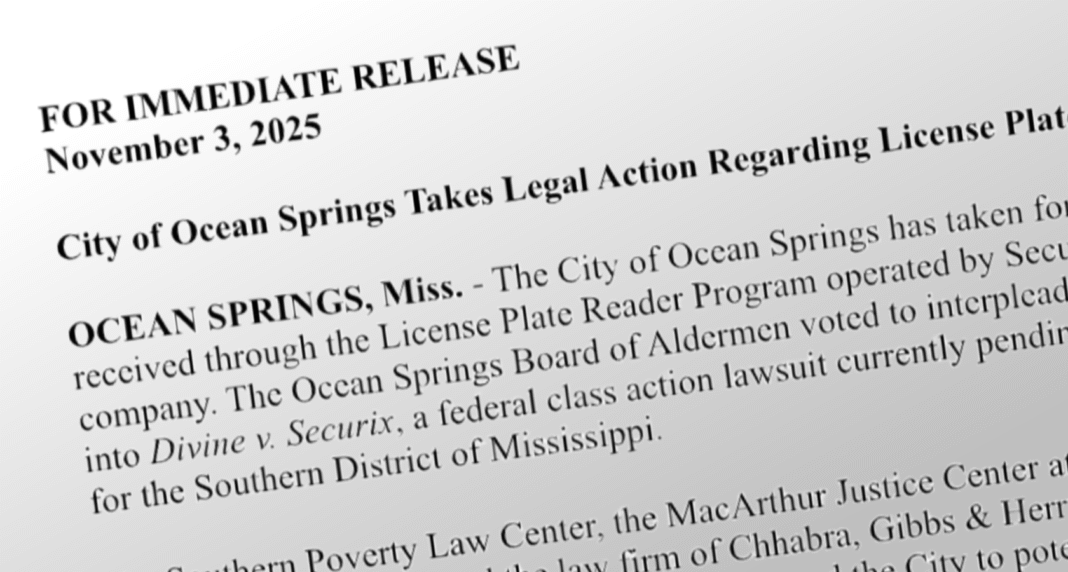
OCEAN SPRINGS, MS — The City of Ocean Springs is once again facing questions about transparency and accountability — this time because of a press release that touted the city’s transparency and accountability.
The controversy stems from metadata in an official press release that contradicts the city’s public explanation about when and how it was created. The discrepancy is especially significant because the press release announced results of a Board of Aldermen vote on the Securix ticketing scandal a day before the vote occurred.
Interpleader Voted On, Press Release Sent Within Minutes
On November 4, the Board of Aldermen spent more than an hour in executive session to discuss a lawsuit tied to the city’s failed Securix traffic-ticket program. During that closed-door meeting, the Board voted to file an interpleader, a legal maneuver that allows the city to transfer nearly half a million dollars in Securix revenue into federal court. If accepted by the judge, the city could be shielded from future claims connected to the program.
Within minutes of that vote, the mayor’s office distributed a press release to local media outlets, including GC Wire, announcing the Board’s decision. The release praised the action as a demonstration of the city’s “transparency” and “accountability.”
But there was a glaring problem: the press release was dated November 3, one day before the Board met or voted.
Twenty minutes later, Mayor’s Assistant and Public Information Officer Laurri Garcia sent a second version with the date corrected to November 4, later describing the original as a “simple clerical mistake.”
The story might have ended there — except the release contained something more consequential than an incorrect date. And the city’s official explanation was inconsistent with the digital evidence.
Metadata Shows the Document Was Created Before the Meeting
The original press release did not simply announce the Board’s action. It also included Mayor Bobby Cox’s reaction to the vote:
“This decision allows the City to do the right thing by ensuring these funds are handled fairly and lawfully through the federal court system. It reflects our commitment to accountability and to protecting the interests of our residents.”
That statement was included in a document dated the day before the vote took place.
And whether the date was corrected later or not, the metadata shows the press release’s description of the action and the mayor’s quote existed before the Board heard the proposal, before deliberation, and before casting any vote.
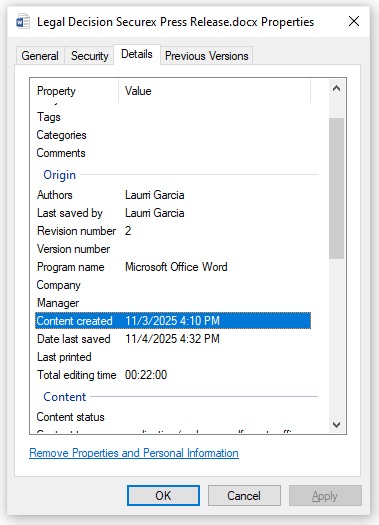
To verify the discrepancy, GC Wire reviewed the metadata embedded in the original Word document distributed by the city.
The metadata shows:
- Created: November 3, 2025 — 4:10 p.m.
- Last saved: November 4 — 4:32 p.m.
- Distributed: November 4 — 9:22 p.m.
The Board did not begin its meeting until 6:00 p.m. on November 4, and did not reconvene from executive session until well after 9:00 p.m.
In response to GC Wire’s request for clarity, Garcia wrote:
“On November 4, 2025 I accidentally dated a press release as November 3… This was a simple clerical mistake.”
But that official response does not match the evidence. According to the file’s metadata, the press release was not created on November 4. It was not mis-dated during preparation. Its creation timestamp is November 3 at 4:10 p.m.
Metadata is not a manual entry. It is an automated, internal record of a Microsoft file’s history. And here, the internal record of the Word document sent by Garcia directly contradicts her explanation.
Why the Timing Matters
At first glance, a wrong date might appear trivial. In context, it is anything but.
Under the Mississippi Open Meetings Act, public bodies must conduct the “formation and determination of public policy” in public meetings, not privately in advance.
A press release and mayor’s reaction drafted before a vote raises several serious questions:
- Was the outcome predetermined?
- Was the Board expected to ratify a decision already made?
- Was the public meeting meaningful, or merely procedural theater?
- Why was the public narrative finalized before deliberation began?
These questions carry added weight because the Securix program itself is accused in a pending federal class action of depriving motorists of due process. Ocean Springs now seeks federal protection from that lawsuit using a legal mechanism typically reserved for neutral third parties.
Writing the announcement in advance undermines the city’s claim of neutrality and transparency.
A Double Standard on Executive-Session Secrecy
The timing of the release is even more notable given recent warnings delivered by City Attorney David Harris.
Earlier this year, Harris told aldermen they could face censure, $10,000 fines, and removal from office if they revealed details of executive-session discussions, despite Attorney General opinions stating that board members may legally discuss executive-session contents.
Yet on November 4, the city itself released a press statement while the Board was still wrapping up its executive session, publicly describing an action that had not yet or barely been disclosed in open meeting.
The contrast raises an obvious question: Why are aldermen threatened with punishment for transparency while the administration creates prewritten statements about executive-session actions that had yet to occur?
Part of a Larger Transparency Pattern
This is not the first time public statements from City Hall have conflicted with the documentary record. Over the past year, GC Wire has uncovered:
- false or conflicting statements to state investigators
- attorney-client privilege asserted where no privilege existed
- inaccurate meeting minutes describing events that did not take place
- court records missing for Securix traffic citations
In that context, the metadata discrepancy is not a footnote. It is consistent with a pattern of controlling the narrative rather than providing transparency.
The city’s press release described the Securix interpleader as a step toward “transparency” and “accountability.” But the document’s own metadata shows it was drafted before the vote took place, included a mayoral quote before the mayor could have known the outcome, and was explained to the public in a way that does not match the record.
For a city attempting to close the chapter on the Securix scandal, the evidence now suggests the public explanation itself may have been authored before the public process began.
And that is not a clerical error.
It is yet another question of trust.