
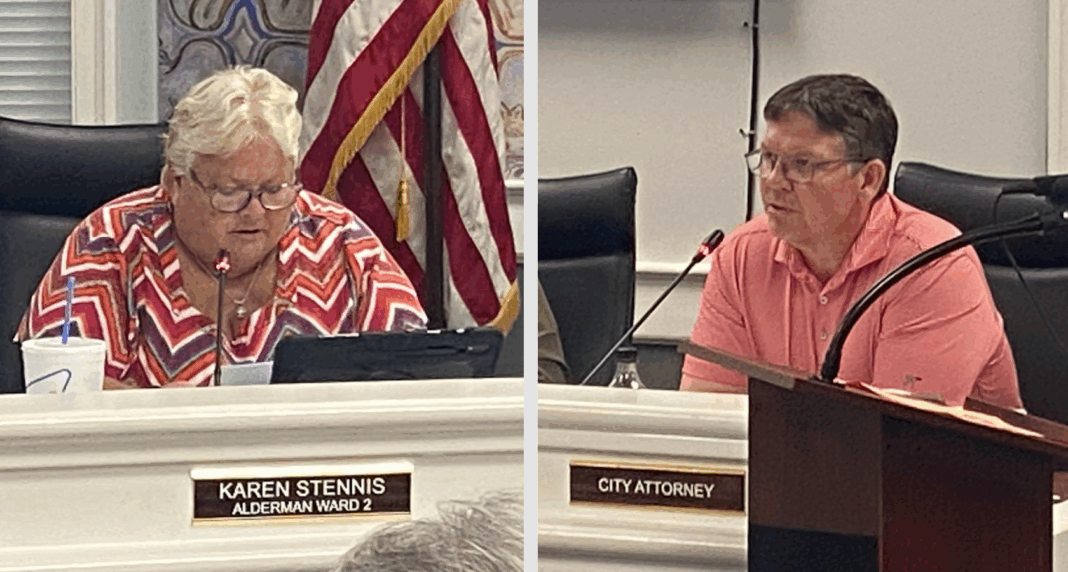
OCEAN SPRINGS, MS – City Attorney David Harris once again misrepresented Mississippi law in an attempt to save his job at Tuesday’s Ocean Springs Board of Aldermen meeting. A majority of elected officials bought it.
A Room Primed for a Fight
Tensions were high. Voices were raised. Accusations flew.
The exchange felt like an ambush that was ready to spring if anyone moved against Harris. When Alderman Karen Stennis did, the reaction was immediate.
Stennis made a motion to invoke a 30 day termination clause in Harris’s contract and return him to an interim position while the city looked for a replacement. She said Harris misled the Board into believing they had no choice but to hire him on a permanent basis after he erroneously cited Mississippi law at an open meeting last month.
Alderman Shannon Pfeiffer seconded the motion. Then a peppered back-and-forth ensued.
How We Got Here
Harris was appointed as interim city attorney during the last meeting of the previous Board and hired on a month-to-month basis.
On September 2, he surprised new Board members by telling them his interim appointment would expire in days; that the code required his new contract to be for a full year; and that failing to act immediately would leave the city unrepresented – a situation Harris said would put the city on the wrong side of the law.
The Board, thinking they had no choice, unanimously approved Harris’s one-year contract.
Last night, Stennis said the city was duped.
“David Harris told this board that the city attorney interim appointment would be automatically expired as a matter of law within days due to the 90 day limitation under Mississippi Code 21-15-41,” she said.
“We were told this would leave the city without an attorney and that state law required we immediately enter into a required one-year contract. When Alderman Blackman asked if a month-to-month agreement was allowed, our attorney said no, it had to be filled for one year. After reviewing the statute myself, I now know that that’s incorrect. 21-15-41 applies to required positions like city clerk, police chief, or judge. But city attorneys are not a required position. That position is governed by 21-15-25, which says the board may annually appoint an attorney, not shall.”
Stennis was correct.
Mississippi Code § 21-15-41 sets limits for interim/hold-over positions “required by law.” The city attorney is addressed separately in § 21-15-25, which says the governing authority may appoint an attorney (and may employ counsel as needed, i.e. on a monthly basis). Because the role is discretionary, § 21-15-41 does not apply.
City Attorney Fires Back
Harris doubled down, this time citing the second paragraph of the 90-day statute.
“On the interim appointment statute, which is 21-15-41, I’ve heard nobody cite the second part of that statute,” he said. “It is the intent of the legislature that the provisions of this section shall apply to all appointees in a holdover interim capacity on July 1, 2018, when the statute went into effect.”
He attempted to convince Board members this language expanded the law to every city position. He argued as if speaking to a jury. But in a courtroom, an opposing attorney would have stood to correct him.
The Law Disagrees
While subsection (2) of Mississippi Code § 21-15-41 does refer to “all appointees” on a specific date, it does not override the qualifying language in subsection (1) that limits the statute’s scope to positions “required by law”. Legal interpretation relies on reading the statute as a whole, meaning all sections must be considered together to determine the overall intent and scope.
The general rule for which positions are governed by the statute is found in subsection (1). This clause specifically limits the law to positions “required by law to be filled by appointment.”
Therefore, the 90 day statute does not apply to every position, but only to those positions required by law that were also subject to the special effective date provision in 2018. City attorney is not one of those positions.
The position of city attorney is governed by a different statute, § 21-15-25, which clearly states a city attorney is optional.
Yet Harris told the Board his position was required by law and that it had to be on an annual basis.
More ‘Not True’ Legal Advice
In her motion, Stennis also pointed to legal advice Harris gave in a closed-door executive session. The Board agreed to waive any attorney-client privilege to allow the debate.
“Recently, four aldermen attended multiple training in Hattiesburg, along with the city clerk and our public information officer,” she said. “At that training, we were advised that several legal claims previously made by our interim city, David Harris, are not consistent with Mississippi law.”
Stennis said Board members were told by Harris they could face a $10,000 fine or be removed from the office merely for discussing matters from executive session.
“At training, we were told that’s not true,” she added.
The warning came after Harris chastised Board members at a September 10 closed-door meeting for giving statements to the press that were critical of him. Several aldermen had previously confirmed Harris told them not to speak to the press and, instead, to “say it to my face.” He went on to say he would be happy to fight them and that he’s “damn good at fighting.”
Harris argued back that his advice was consistent with the law, citing the Mississippi Ethics in Government Act – a law that penalizes intentional use or disclosure of non-public information for pecuniary gain.
After Harris originally told aldermen they could be penalized for revealing any information from executive session, GC Wire published an Attorney General opinion that stated, “Nothing in the law prohibits a member of a public body from informally revealing what occurred at an executive session…”
Last night, Harris shifted his stance, saying he cannot prevent officials from revealing what is discussed in executive session, but doing so may have legal consequences. He said because the statements critical of him were made to a reporter who is suing the city for First Amendment retaliation, they could be construed as helping that litigant and could trigger penalties.
That is a stretch. The Ethics Act does not convert ordinary criticism or routine conversations with a journalist into a finable offense, even if that journalist is suing the city.
Harris’s claim drew an immediate response from Pfeiffer.
“Okay, hold on there, Mr. Harris. Now I’m going to speak,” the Ward 4 Aldermen interrupted.
Pfeiffer told Harris he manipulated the penalties associated with the Ethics Act to fit to a narrow and unrelated narrative. “You don’t think we know the law, but we do,” she added. “You continually misrepresent your clients, this board, for your own personal benefit. So this [ethics] law may very well apply to you.”
Harris responded, “I just admonished you, or the Board, from disclosing information regarding litigation strategy to the actual person seeking money from the city.” But no litigation strategy was given and it appears Harris’s reason for admonishing the Board was rooted in his dislike of critical statements made about him appearing in the press.
Open Meetings Law and Contract Irregularities
Stennis recalled from the September 10 private session that Harris may have also violated the state’s open meetings law, arguing that his discussion about Board members criticizing him to the media should have been done in the public.
“You have a captive audience in that executive [session], and you were asked specifically if this is executive material… It should have come out here. It must be discussed in an open meeting and cannot be in an executive session,” she said.
Stennis also pointed out that Harris’s contract was back-dated to before the Board approved it and that it exceeds one year. The law allows the city to contract with a city attorney for up to one year at a time. Harris did not dispute those points; he confirmed them.
Other than playing referee, Mayor Bobby Cox mostly stayed out of the argument, with the exception one line telling Stennis her arguments could be misconstrued depending on the way they are posed or asked. He did not offer the same criticism for Harris’s arguments. Despite Stennis’s arguments, the Board accepted Harris’s misreading of the laws. The motion failed 2–5, with Stennis and Pfeiffer the only votes to hold Harris accountable.
(Editors Note: Several actions occurred at the October 7, 2025 Board of Aldermen meeting. Each will be addressed in separate news articles.)



It sounds as though OS did not get a better mayor this time. And it certainly sounds as if Harris misrepresented the law, in other words, his opinion of the law. Harris should be held accountable and give that 30 day termination notice. Just my opinion.