
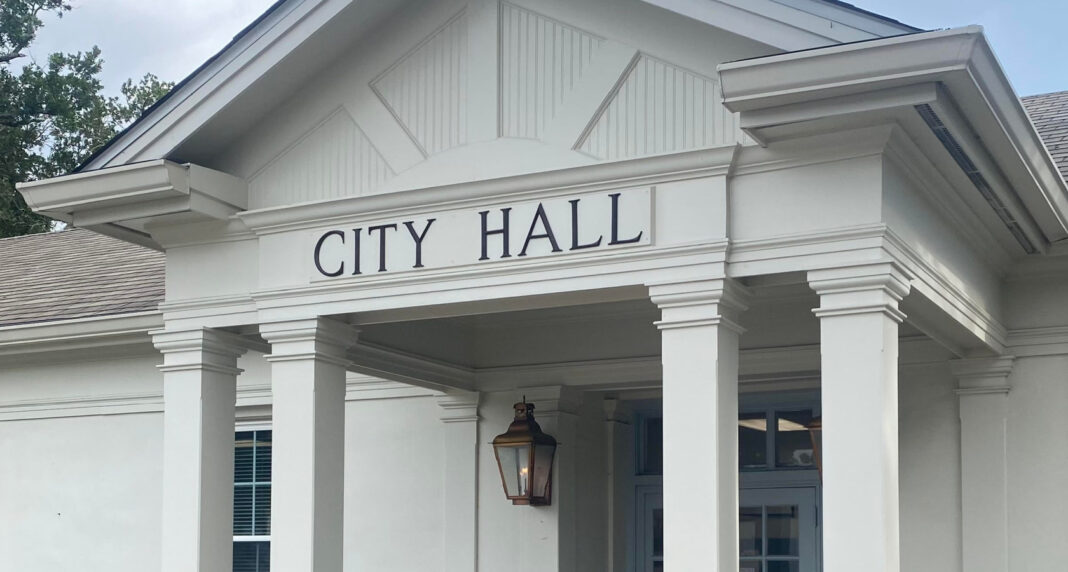
OCEAN SPRINGS — When the Ocean Springs Board of Aldermen slipped behind closed doors last week to decide whether to keep former City Attorney Robert Wilkinson’s private law firm on the payroll, the stated reason was “litigation.” But Mississippi Attorney General opinions and Open Meetings Act precedent tell a different story: the board had no legal authority to discuss retaining an independent contractor in secret.
Wilkinson has been a lightning rod in Ocean Springs politics, facing public criticism over conflicts of interest, his role in the city’s controversial Securix traffic ticket program, and accusations of retaliating against critics — all issues that have drawn packed crowds to past meetings and fueled demands for transparency.
Last week, the Board voted to keep Wilkinson’s firm as the attorney of record for multiple pending lawsuits the city is involved in. Critics argue the decision to discuss and vote on Wilkinson’s contract in private was made to shield him, as well as Board members, from further public scrutiny.
What the Law Says
Executive session is the portion of a public meeting the law allows to be closed for narrowly defined reasons, such as active litigation strategy and personnel issues, but it cannot be used as a shield for contract decisions the public has a right to witness and weigh in on.
Mississippi’s Open Meetings Act allows boards to meet privately in executive session for litigation strategy or for certain personnel matters involving employees — but not for deciding whether to hire or retain an independent contractor.
In Opinion No. 2009-00306, the Attorney General’s Office wrote:
“There is no authority for the Board to enter into executive session to discuss the employment of an individual as an independent contractor.”
The ruling leaves little room for interpretation — any discussion about whether to keep an independent contractor, even one who serves as legal counsel in active cases, must take place in public.
Additionally, the public must be made aware of what topics are being discussed in executive session. Prior to the August 5 session, the public was told the closed door meeting would potential litigation, as well as two other pending federal lawsuits. The clerk did not inform the public that Wilkinson’s contract would be discussed, as the law prescribes.
No Litigation Strategy Discussed
According to multiple alderman present in the meeting, the “litigation” portion of executive session consisted of Interim City Attorney David Harris informing the Board of a list of lawsuits Wilkinson’s firm is handling and noting their procedural status — all information already public on federal PACER and state MEC court databases.
No strategy, settlement offers, or confidential matters were discussed. Instead, the conversation centered on the pros and cons of keeping Wilkinson as a contracted attorney — exactly the kind of discussion the 2009 AG opinion says cannot be held behind closed doors.
In other words, the type of information shared could have just as easily been conveyed in open session without jeopardizing the city’s legal position.
But even if strategy was discussed, the moment the topic shifted towards retaining Wilkinson’s firm, the Board should have shifted back into public session.
The Attorney General’s Office has also made clear that straying from the publicly announced topic in executive session is not a harmless technicality. In a 2007 opinion to a Biloxi City Councilman, the AG wrote:
“The discussion during an executive session of the Biloxi City Council must be limited to matters disclosed to the public as exempted from the open meeting pursuant to Miss. Code Annotated Section 25-41-7(4). We further opine that pursuant to Section 25-41-15, members of the Biloxi City Council may be subject to liability for willfully and knowingly violating the Open Meetings Act.”
That opinion suggests that once the board shifted from publicly announced “litigation” to debating whether to keep Wilkinson under contract, they stepped outside the legal boundaries — and did so in a way that Mississippi law says can trigger personal liability for the participants.
In practice, aldermen often rely on the city attorney to guide them on what the law allows in executive session, since most are not legal experts themselves. If the board relied on legal guidance that incorrectly broadened the scope of the exemptions, the real question becomes whether the willful violation rests with those who acted on flawed advice — or with the one who gave it.
Can Aldermen Blow the Whistle?
Despite widely spread contradicting information, aldermen are not bound by any statute to conceal what occurs in executive sessions. The Mississippi Attorney General made that clear in a March 4, 1982 opinion (1982 WL 44189), stating:
“Nothing in the law prohibits a member of a public body from informally revealing what occurred at an executive session, but such revelation is not official and the minutes are the only [official] record of what actions were taken at any board meeting, open or closed.”
This means silence is a choice, not a legal requirement, and any alderman who believes the public was wrongly excluded has the authority to set the record straight – even if the board majority would prefer otherwise.
A Break From Tradition
As recently as 2024, the Board openly debated and voted on whether to hire or keep outside law firms. Moving the Wilkinson decision into executive session was a departure from that practice.
In June 2024, the agenda openly listed a vote to authorize the Mayor to execute the continuing engagement with the law firm Butler Snow. Residents had the opportunity to speak before the Board voted. In December of that same year, another public agenda item sought approval to hire the Wise Carter law firm for zoning work in newly annexed areas, again allowing for public comment before the vote.
The August 5 vote, which resulted in a 5-2 decision to keep Wilkinson’s firm on the payroll, never appeared on a public agenda. Instead, it was buried inside a closed-door executive session slated to discuss “litigation,” with the public informed about the vote only after the decision was made.
Multiple city hall sources say the shift was intentional: to shield Wilkinson from anticipated public criticism and to spare aldermen from having to defend their votes in front of a packed room.
The Specificity Problem
A separate AG opinion from 1991, citing the Mississippi Supreme Court’s ruling in Hinds County Board of Supervisors v. Common Cause, requires the reason for executive session to be “specific, discrete, and identifiable” — not a vague label like “pending litigation.”
By lumping unrelated lawsuits with a generic “pending litigation” label, the board left the public with no meaningful understanding of what was being discussed, which is exactly the kind of vague justification the court warned against.
“To simply say, ‘personnel matters,’ or ‘litigation, tells nothing,” the opinion stated.
Why It Matters
If the Board used the litigation exemption as a pretext to privately decide Wilkinson’s contract, it wasn’t just breaking with tradition — it was bypassing the public’s right to witness and participate in deliberations on a matter of public spending and trust.
The AG opinions are not advisory fluff; they are legal interpretations used by courts and the Ethics Commission to decide whether public bodies broke the law.
Public Set to React
Some residents say the board’s closed-door vote should not stand. Ellen Hall, one of the founding members of the municipal watch-dog group SaveOS.org, says her organization is mobilizing.
“We are asking our members to put pressure on the board at the next meeting,” Hall said. “The board knows residents have strong feelings about Wilkinson and that their opinions should come into play.”
Mike Illanne, a fellow director of SaveOS said “We believe residents would have liked to have voiced their opinions.”
Hall says she’s urging supporters to attend the upcoming August 19 meeting to demand that aldermen make a motion to nullify the vote taken in executive session.
“They should revote only after the public has had a chance to weigh in,” she added.
If the board refuses, Hall says SaveOS will explore filing a formal Open Meetings Act complaint with the Mississippi Ethics Commission — a process that can lead to civil penalties, public reprimands, and, in rare cases, court action to void improperly taken votes.
Interim City Attorney David Harris did not respond to requests for comment prior to the publishing of this article. GC Wire will update should such comments be made available.
The Ocean Springs Board of Aldermen is set to meet again Tuesday August 19 in City Hall at 6:00 p.m. The meeting is open to the public and will include opportunities for public input. Whether next Tuesday’s meeting brings a reversal or not, state law and AG opinions make clear this was a decision that should have been made in the open — in front of the people it affects.


One would assume the new SaveOS supported BOA members would be appalled by close door meetings. Things that make you go Hmmmm.
The longer Wilkinson remains involved with Ocean Springs, the more suffering the City faces. We have never as he claims threatened to file because the City terminated the Securix contract but there are 67 other lies documented and often sent by him to the Bar Association and attorneys that are disgusting and the more the City tries to protect him, the more embarrassing it will be. The fact that City Attorney Harris’ Father is handling a case involving Wilkinson who is responsible for serious crimes involving up to $100 million in fines and has instructed i will be jailed if I speak with the FBI again tells you one thing…. This will not end well. Targeting people and violating privacy at an “industrial scale” was never a good look for the City. Wilkinson is toxic in the opinion of many and again we offer to provide proof that this was never about “defamation” but only a massive coverup. It needs to end. Set up a townhall meeting. We can provide solid proof for every statement. People whose own records prove they have committed crimes or instructed that others commit crimes tens of thousands of times are called criminals for good reason. Protect your city and stop allowing illegal and destructive conduct. Ocean Springs deserves better … much better.
This is a conflict of interest all around! Shield an attorney who has a major conflict of interest as well as has told some very tall tales? And on top of that the Judge D. Neil Harris should recuse himself from this due to his son being the Attorney for Ocean Springs. Yes Ocean Springs you do deserve much better!
In submissions to authorities Securix has discovered that Wilkinson – his fake proxy “Par Yachts, LLC” along with an LLC of Josh Gregory ..also a shell company to avoid transparency and controlling the Securix Mississippi bank account paid Dunston… who works with IntelliSafe, $48,000. That was never authorized and that is just more stolen money like the over $365,000. stolen from DPS. The “Wilkinson-Harris-Gregory Rot” is far deeper and more disgusting than people realize and Aldermen need to protect their citizens and demand that Federal Authorities and the AG’s Office immediately investigate. Again….our records are open to all and we will not be silenced. The people must demand what they so richly deserve… action. We can prove they stole our money and that of the state and violated the privacy of tens of thousands. These elitists who think they are better than you need to answer for their crimes. Rise Up Ocean Springs!