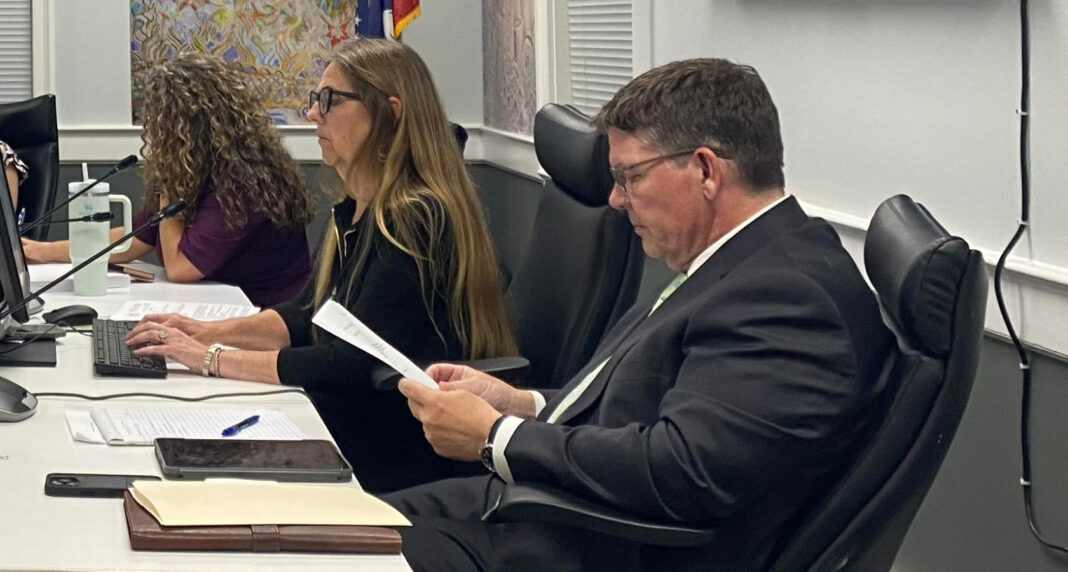
OCEAN SPRINGS, MS – Mississippi State Representative Trey Lamar took to social media to post a public rant that erroneously accused GC Wire of publishing an “outright lie” about his ties to the Securix ticketing scandal – despite overwhelming evidence to the contrary.
Instead of disputing the documented facts, Lamar attacked the journalist behind the report, even going so far as to call for an “investigation” into the reporter who exposed his name in internal Securix communications.
Lamar, who currently serves as Chairman of the Mississippi House Ways and Means Committee, was referring to a GC Wire report titled, “What a Tangled Web: The Power Players Behind Wilkinson’s Ticket Empire.”
That article revealed the network of political figures, consultants, developers, and public officials involved in an uninsured motorist ticketing venture that often operated with little to no judicial oversight — a program later shut down by the Mississippi Department of Public Safety.
Trey Lamar’s Involvement
Among the list of names reported having ties to the Securix controversy was Representative Trey Lamar. The May 23rd GC Wire expose reported:
“State Representative Trey Lamar, a top-ranking member of House leadership, played multiple roles in the Securix saga. In an email to Robert Wilkinson, Josh Gregory described Lamar as an influential legislator who is “super impressed” with the program. Gregory credited Lamar with making the introduction to the Senatobia mayor, which resulted in a signed contract with Securix. Lamar represented Senatobia in litigation arising from the program – with legal fees reportedly paid by Securix. Later, Lamar was added to the Securix ‘consultant’ list of people to be paid $6 per traffic citation. Lamar currently serves as the chairman of the Mississippi House Ways and Means Committee.”
The information reported came directly from internal Securix documents obtained by GC Wire.
Lamar’s First Dishonest Reaction
Despite the accuracy of the reporting, Representative Lamar sent a letter demanding GC Wire remove the article. And his letter began with a lie.
Lamar’s main complaint was for a line that wasn’t even in the article. In his June 2nd letter, Lamar misstated what was published in the report:
“It has been brought to my attention that on May 23, 2025 GC Wire and its editor E. Brian Rose published a news article using my name and image while representing that I ‘played multiple roles in the Securix saga.’ GC Wire further reported that I served as a consultant for Securix and was ‘paid $6 per traffic citation.’”
That is not what the article reported. It stated Lamar was the subject of multiple internal Securix emails and documents that had placed his name on a list of consultants – like this one. And this one.
The letter then addressed GC Wire’s claim that Lamar represented Senatobia in litigation and his attorney bill was paid for by Securix. He confirmed this fact by stating, “It is my understanding that Securix did pay the legal costs incurred by the City as a result of this litigation.”
Despite the accuracy of the reporting, Lamar branded the article as false and asked for a redaction:
“I do not condone the dissemination and spread of false and misleading information. Accordingly, I respectfully ask that GC Wire and its editor E. Brian Rose properly redact and edit its publication to reflect the truth of this matter as it relates to myself and my likeness.”
GC Wire Promptly Responded
On the same day Lamar sent the letter via Facebook’s Instant Messenger, GC Wire made a public response on the same platform. Here is what we wrote:
Dear Representative Trey Lamar,
Thank you for your June 2 letter regarding GC Wire’s article, “What a Tangled Web…,” in which five sentences pertain to you.
You begin by asserting that the article is “categorically false.” Yet, remarkably, your own letter proceeds to confirm nearly every point made in our reporting, including:
– That your law firm represented the City of Senatobia in litigation stemming from its Securix contract;
– That Securix paid the legal fees incurred by the city in that matter.
Our article reported exactly those facts.
What your letter does not dispute — and what remains one of the most significant disclosures in the article — is that your name appears in internal communications listing you among a group of individuals referred to as “consultants” slated to receive contracts and compensation related to the Securix program.
To quote from a February 21, 2022 email authored by Josh Gregory and sent to Robert Wilkinson, Jonathon Miller, and others:
“Here are our ‘consultants’ that have helping us in various areas. Robert and I are going to work on getting these contracts out this week.”
Your name is included in that list as:
“Trey Lamar, Senatobia – Trey helped introduce us to the mayor of Senatobia. He’s top 3 House leadership is super impressed with the program.”
Additional internal communications between Gregory, Wilkinson, and others identify the same consultant list — including your name — as being slated to receive $6 per traffic citation.
The individuals listed were not chosen randomly; they were described as strategically placed allies, being queued for contracts and potential payment in relation to the program’s expansion across Mississippi.
You now assert that you were never compensated and had no formal agreement with Securix. However, in the same letter, you state that Securix paid the legal fees for your representation of Senatobia in litigation resulting from the program. That is, by any reasonable standard, a form of compensation — whether direct or indirect.
Importantly, our article did not claim that you were paid as a consultant. It reported that internal documents placed you on a consultant list “to be paid,” as described by the program’s own strategists. That is a factual and material distinction.
You may disagree with how those insiders characterized your role, but reporting what they said — especially when it pertains to public business and state actors — is not defamatory. It is journalism.
You also mentioned that the Senatobia litigation is a matter of public record. To our knowledge, the case file is sealed — a fact that drew considerable interest.
We were able to review the documents only because they were shared with us by another member of the Mississippi State Legislature — a legislator who, like us, questioned why litigation involving a public municipality and the Department of Public Safety would be shielded from public view.
Finally, your letter states that we did not seek comment from you prior to publication. The article was based on verifiable public records and internal emails authored by principals in the Securix operation — emails in which you were named directly.
Under these circumstances, additional confirmation was not necessary to report those documents accurately.
In summary, your letter:
– Labels the article as false,
– Then confirms its core facts,
– And then asks that it be taken down anyway.
We respectfully decline. The article will remain published, and we stand by the accuracy, documentation, and public value of the reporting.
Please respect the First Amendment, especially when it deals with public officials mixing private business with public contracts that are designed to fine citizens for traffic violations.
Accurate reporting about public figures and public programs should not be removed just because it may cause discomfort.
If you would like to submit a formal statement for potential inclusion in a future update, we are happy to consider it.
Sincerely,
Eric Brian Rosenberg
aka E. Brian Rose
Publisher, GC Wire
Lamar’s Second Dishonest Reaction
On July 3rd, Representative Lamar made more false statements – this time publicly on Facebook.
In response to a post made by a group called “TateCounty Watchdogs” that asked for residents to contact them regarding Securix tickets, Lamar wrote:
“We do not normally comment on these pages, but this outright lie needs to stop immediately. For the record, here is a copy of the letter sent on June 2 to E. Brian Rose who is the self appointed editor of his own personal blog that he calls GC Wire. The letter sets out the truth about these allegations as they relate to Trey Lamar. For anyone who might care E. Brian Rose is a fake name (ie. alias) for the man’s legal name which is Eric Rosenburg whom Mr. Lamar does not know and who he has never met. Maybe the watch [dogs] should go investigate that. Mr. Rosenberg refused to publish the letter. It speaks for itself. Truth matters. Thank you.”
Instead of addressing the well documented facts of the report, Lamar chose to attack the reporter. He, once again, made erroneous claims, this time publicly referring to the report as an “outright lie.” The comments were published from the official Trey Lamar Facebook page.
Lamar then went on to rant about the nom de plume used by this reporter, which is actually a derivative of my actual name and has been used for decades in writings. He failed to state that the public letter was signed “Sincerely, Eric Brian Rosenberg, aka E. Brian Rose” or that my full legal name appears clearly in my Facebook bio. Nowhere in his post did he mention his name is not actually Trey. Rep. Lamar’s real name is John Thomas.
Lamar then suggested this reporter be investigated, rather than his own ties to the controversial Securix program.
No Accountability, No Respect for the Constitution
Representative Trey Lamar’s responses to accurate reporting are telling. He was given the opportunity to submit a formal statement for future reporting, but instead chose to attack the journalist.
Elected officials using the language or suggestion of investigation against a journalist — simply for exposing uncomfortable truths — is a serious matter. Whether meant as a literal call to action or a rhetorical smear, the effect is the same: a chilling message sent to the press and the public that investigative reporting may be punished with retaliation.
Rep. Lamar has every right to dispute facts or offer clarification. But publicly calling for an “investigation” of a journalist crosses a dangerous line. It violates the spirit of democratic governance and undermines public trust in the independence of the press. Coming from a senior lawmaker — and the current Chairman of the House Ways and Means Committee — it carries weight that makes the threat more than rhetorical.
When lawmakers turn their power against the press instead of the problem, it’s not journalism that should be under investigation — it’s them.