
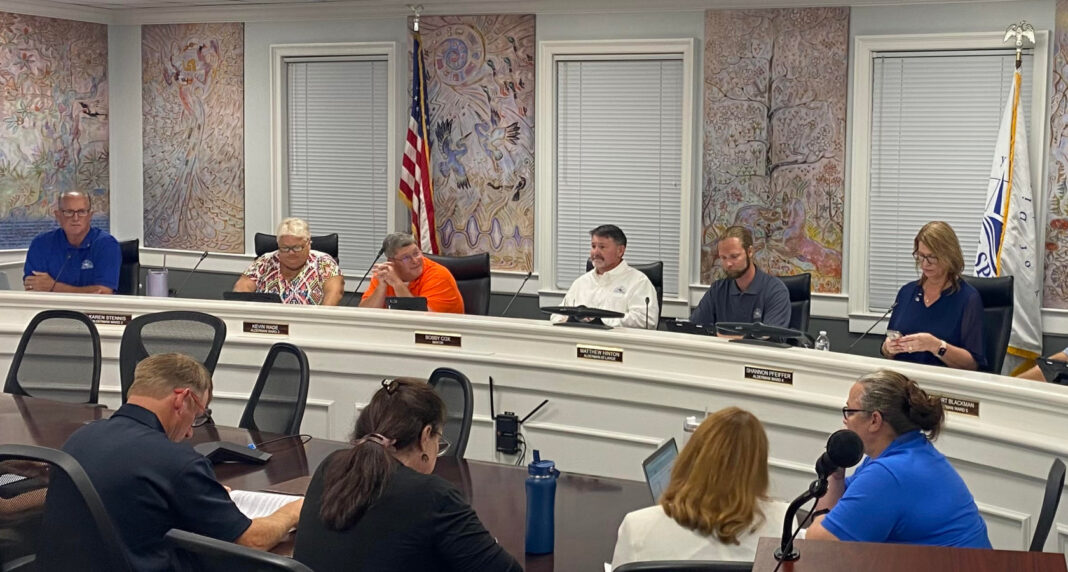
OCEAN SPRINGS, MS – A new two-page document titled “City of Ocean Springs – Resolution Process and Procedure Guidelines” appeared in the mailboxes of all seven aldermen this week, without explanation, authorship, or a vote. Among its most surprising claims: city staff control the flow and even have the authority to submit legislation for consideration by the Board of Aldermen.
The document outlines a step-by-step process for how resolutions are to be created, reviewed, and placed on the board meeting agenda. But despite its formal tone and presentation, it is unclear whether the memo is official policy, a staff proposal, or something else entirely.
A resolution is a formal expression of intent or decision traditionally introduced and voted on by the elected Board members, often used to establish policy, authorize contracts, or direct city action.
Alderman-at-Large Matthew Hinton, who recently told the public he would like the board members to publicly discuss ideas to streamline the resolution process, told GC Wire that this document was not the result of that effort. He said he believes someone from the city clerk’s office authored the guidelines and confirmed no cover note or explanation was included when it was distributed. “It was just that double-sided document, nothing else,” Hinton said.
At least two other alderman agreed with Hinton’s description and some said they believed it was meant as an official policy statement when they received the document.
Alderman Shannon Pfeiffer questioned the timing of the guidelines. “We have to ask why the city wants to formalize a process of control now,” she said. “We need to ensure the elected officials are able to put their ideas in front of the public and up for vote, without barriers. That is transparency. Period.”
Steve Tillis, who represents Ward 1, stated he did not know the origins of the document. “We questioned who dropped it off” the alderman said. “I didn’t know if was from another alderman, the city clerk, or maybe the deputy clerk. I still don’t know who sent it.”
Meanwhile, other officials familiar with the memo have given conflicting descriptions of its origin and purpose. Some have described it as a joint effort involving multiple elected officials and staffers, but as of this writing, no one has publicly taken responsibility for authoring or approving it. The Board of Aldermen has not held a vote on it, and the guidelines have not appeared on any recent public agendas.
A faithful reproduction of the version distributed to aldermen on August 6 can be seen here.
What Did the Document Say?
The document lays out what appears to be a formalized process for introducing and adopting resolutions, but with some troubling implications. It begins by stating that a resolution may only be drafted “once authorized,” though it does not define who gives that authorization or under what conditions. According to the memo, only after “internal review and approval” is a resolution allowed to appear on a Board agenda.
It also centralizes control with the City Attorney, stating that all resolutions must be reviewed and approved by legal counsel before placement on the agenda. No language is included to clarify whether an alderman can introduce a resolution independently or override staff objections.
Other sections indicate that resolutions may be placed on the consent agenda, where they can be passed with no public discussion or individual vote, if deemed “routine.” The document does not explain who makes that determination. Finally, it discourages naming individual aldermen in the resolution text, effectively erasing the public’s ability to know who proposed what.
If enforced, the process outlined in the memo would shift key legislative power away from elected officials and into the hands of staff and legal contractors, without any public oversight or vote.
Who Can Actually Introduce Legislation?
The first section of the memo claims that resolutions may be submitted by “a Board member, the mayor, or City staff.” But under Mississippi law, only members of the Board of Aldermen are vested with legislative authority. The mayor’s role is to preside over meetings and cast a tie-breaking vote — not to introduce legislation.
As for City staff, they are hired to support the legislative process, not initiate it. While staff may assist in drafting resolutions when asked, they cannot lawfully propose laws or bring items forward for a vote. Any process that allows the mayor or staff to submit legislation on their own authority misrepresents how representative government works—and undermines the separation between elected decision-makers and administrative employees.
How the Process Is Supposed to Work
The founding vision of this country was built on a simple premise: those elected by the people should be the ones shaping the laws that govern them. Representatives are chosen to bring forth ideas, advocate for their constituents, and cast votes in full view of the public they serve.
City government operates under the same principle. Aldermen are not figureheads — they are lawmakers. Their authority to propose legislation does not hinge on approval from staff or legal advisors. The role of city employees, including the city attorney, is to assist — not to authorize, delay, or deny.
When unelected staff are positioned to filter or block legislation before it reaches the full board for discussion, the balance of power shifts in the wrong direction. It cuts the public out of the process and leaves important decisions to people who were never on the ballot. That’s not how representative government works. It’s not how it’s supposed to work anywhere.
Giving staff or attorneys the ability to decide which proposals make it to the agenda — and which are quietly discarded—undermines the entire structure of local self-governance.
A Pattern of Unelected Power
The situation surrounding the resolution memo is not an isolated one. In Ocean Springs, it has become increasingly common for key decisions — and at times, even policy — to originate not from elected officials, but from bureaucrats operating behind the scenes.
Nowhere has this been more evident than in the city’s now-defunct partnership with the Securix traffic enforcement program. In 2021, the Board of Aldermen passed a resolution to contract with the company, but key parts of the agreement were ignored. Instead, program decisions were quietly directed largely by former City Attorney Robert Wilkinson and his son, Alexander, who took on a leadership role in the company while his father served as legal counsel to the city.
Rather than being guided by public votes or transparent oversight, the Securix program evolved based on internal decisions made by a small group of individuals, some of whom had financial or legal ties to the project. The result was a ticketing system that operated outside the city court and ultimately collapsed under legal scrutiny.
The issue of unelected influence surfaced again last month, when the minutes from the July 1 executive session included a “vote” that all seven aldermen later stated never occurred. The phantom vote, inserted into the official record by Interim City Attorney David Harris Jr., was quietly removed only after GC Wire questioned its legitimacy. All seven members of the Board voted to strike it from the record, with no objections.
Together, these incidents paint a picture of a city government where staff and those in legal roles wield disproportionate influence over how policy is shaped, enforced, and remembered. Whether the memo in aldermen’s mailboxes was meant to formalize that dynamic or not, it reflects a larger trend: in Ocean Springs, the levers of power are often pulled by people the voters never elected.



Regarding this document that just appeared in those mailboxes with no author or office it came from, I believe I would shred it. This appears to be just the begining of more corruption. Your alderman are your lawmakers elected by the people. Hopefully this mystery is solved soon.