
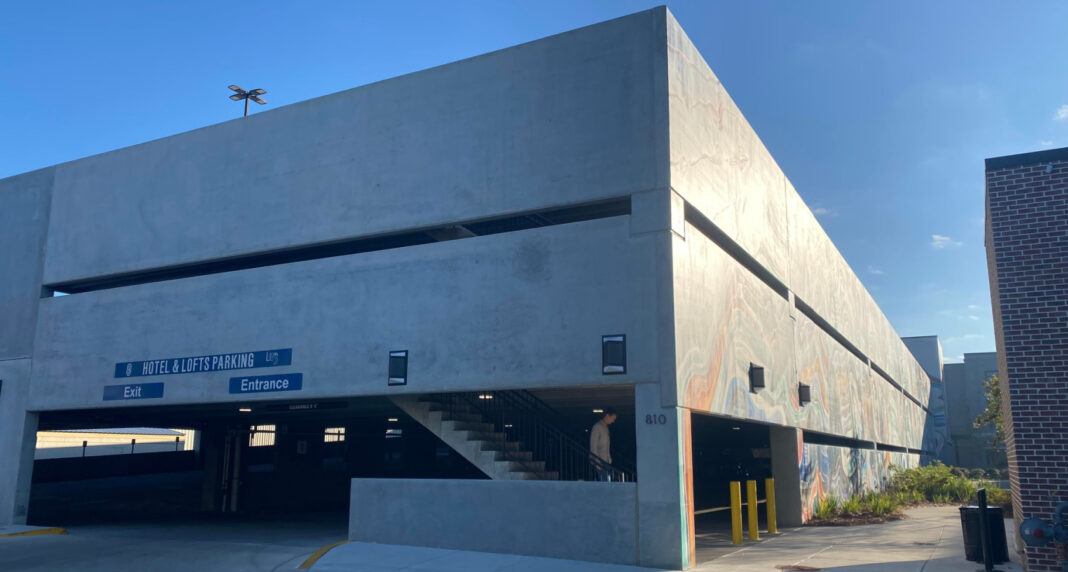
Aldermen approved the controversial agreement after repeated questions about ownership, grant requirements, and public protections went unanswered.
OCEAN SPRINGS, MS (GC Wire) – After months of controversy, unanswered questions, and mounting public scrutiny, the Ocean Springs Board of Aldermen voted 4-3 Monday night to approve a lease agreement for the downtown parking garage. Supporters of the lease repeatedly warned that failure to approve the agreement could expose the City to litigation, jeopardize future grant opportunities, and potentially leave taxpayers responsible for millions of dollars in grant funds already spent on the project.
Yet throughout the meeting, aldermen opposing the lease repeatedly challenged those assertions and asked a simple question: where, exactly, do the governing grant agreements require the City to sign a lease or establish June 30, 2026 as a deadline for doing so?
The question surfaced again and again during the debate. Aldermen Karen Stennis and Shannon Pfeiffer repeatedly asked supporters of the lease to identify the specific language creating those obligations. They asked where the agreements require a lease. They asked where the June 30 deadline appears. They asked where the City supposedly assumes responsibility for repaying more than $8 million if a lease is not executed.
No one identified a section of any grant agreement. No provision was cited. Instead, supporters pointed to conversations with Mississippi Development Authority officials, an MDA letter, concerns about future grant funding, and the possibility of litigation. By the end of the evening, the lease had been approved, but the central question underlying the debate remained unanswered.
That question matters because the lease approved Monday is not simply an agreement governing maintenance and public parking. It leaves ownership of the publicly funded garage in private hands, guarantees public access only through June 2029, remains subordinate to current and future mortgages, and contains no obvious protection ensuring continued public access if the property is sold, foreclosed upon, or ownership changes. In other words, the Board approved a lease intended to resolve years of controversy while many of the fundamental questions that created the controversy remain unresolved.
How We Got Here
The parking garage at the center of Monday night’s controversial vote was funded through approximately $8 million in Mississippi Gulf Coast Restoration Fund grants administered by the Mississippi Development Authority.
Those funds originated from BP settlement proceeds paid following the Deepwater Horizon disaster and were intended to support projects benefiting Mississippi’s Gulf Coast communities.
Unlike a traditional public infrastructure project, however, the parking garage was structured as a joint venture between the City of Ocean Springs and private developer OHOS. The City and OHOS jointly sought and received public funding for construction of the downtown garage and related development.
Since the project was announced, one question has consistently overshadowed every other issue: who was ultimately supposed to own the garage?
Grant applications submitted to state officials described a project in which ownership of the parking garage and related public amenities would be transferred to the City upon completion. Opponents of the lease argue those ownership representations formed the basis upon which public funds were awarded. Supporters contend the project evolved into a lease arrangement and, as City Attorney David Harris recently put it, claims the City will own the parking garage in grant agreements were merely a “sales pitch.”
That disagreement has fueled years of public records requests, media investigations, legal disputes, and increasingly contentious public meetings.
Monday night’s vote did not resolve that disagreement.
It intensified it.
The Public Was Given Forty Minutes
Residents were given less than one hour to review the final lease agreement before the vote.
The amended lease was uploaded to the City’s public agenda website at approximately 4:40 p.m. Monday afternoon. The special meeting began at 5:30 p.m.
The public was not allowed to speak before the vote.
Comments on the City’s Facebook page were disabled.
Comments on the City’s YouTube livestream were disabled.
As elected officials debated the future of one of the largest publicly funded projects in recent city history, residents were effectively reduced to spectators.
Even Alderman Julie Messenger expressed concern.
“I would have liked to have heard from or the public to have more opportunity to speak on this.”
The opportunity never came.
The Lease Creates New Risks
Supporters framed the vote as a practical necessity.
The lease itself tells a different story.
Under the agreement approved Monday, the City’s right to use the parking garage expires on June 30, 2029. After that date, renewal is not automatic. Instead, the agreement states it may only be renewed through “mutual consent on acceptable terms.”
In plain English, either side can walk away.
The lease leaves ownership entirely in private hands. It contains no ownership transfer to the City, no purchase option, and no guaranteed public access beyond the initial term.
Perhaps most concerning, the lease remains subordinate to existing and future mortgages.
Taxpayers funded construction of the garage through more than $8 million in public grant money, yet the lease contains no provision guaranteeing that public access survives a sale of the property. Nor does it contain any obvious protection if ownership changes hands, financing issues arise, or the current owner defaults on its obligations.
Residents have repeatedly been told this garage was built for public benefit.
The lease approved Monday guarantees public access only through June 2029.
‘Where Does it Say That?‘
The most forceful opposition to the lease came from Aldermen Karen Stennis and Shannon Pfeiffer.
Although they approached the issue from different angles, both argued that the Board was being asked to approve a lease built upon unresolved questions that have never been adequately answered.
Stennis repeatedly argued that the only grant agreements ever authorized by the Board were the original 2022 agreements. According to Stennis, those agreements contemplated City ownership of the garage, not a long-term lease arrangement with a private developer.
She further argued that the amended grant agreements being cited by supporters of the lease cannot be found anywhere in the Board’s official minutes as approved actions.
“If it’s not in the minutes, it didn’t happen,” Stennis stated.
Throughout the debate, Stennis maintained that the City was being pressured to act based upon agreements she believes were never properly authorized by the Board and cannot be located in the official record.
Pfeiffer focused on the practical consequences.
She questioned why taxpayers should approve a lease that leaves ownership in private hands, remains subordinate to bank financing, provides no obvious protection if the property is sold, and guarantees public access only through 2029.
The lease, she noted, contains no ownership transfer to the City and no clear safeguard protecting taxpayers if the current owner defaults on its loans or transfers the property to another party.
As debate intensified, Pfeiffer challenged repeated warnings that future funding opportunities could be jeopardized if the lease was rejected.
“If you’re telling me that if we don’t approve an eight million dollar grift tonight that will influence future funding, I’d like some things in writing to that effect.”
Both aldermen argued that questions should be answered before the lease is approved.
Monday night, those questions remained unresolved.
Hinton’s Extraordinary Claim
One of the most significant statements of the evening came from Alderman Matthew Hinton.
While advocating for approval of the lease, Hinton told the Board that “there’s a lot of things that are basically being contingent upon this lease being finalized.”
That assertion immediately raised the stakes of the debate.
If approval of the parking garage lease truly affects other infrastructure grants, taxpayers deserve to know exactly which projects are involved, what agencies are making those decisions, and where those conditions are documented. Grant requirements are typically spelled out in applications, award letters, agreements, or agency correspondence.
Yet no such documentation was presented during the meeting.
Pfeiffer challenged the claim directly, arguing that if future funding is actually contingent upon approval of what she described as an “eight million dollar grift,” those conditions should be put in writing and shared with the Board and the public.
No documents were produced in response.
Instead, the discussion moved on without identifying a single grant, agency, project, agreement, or written requirement supporting Hinton’s statement.
That leaves residents with a series of unanswered questions. What funding opportunities are allegedly at risk? Who made that determination? When was the City informed? And perhaps most importantly, where is the documentation?
The statement was offered as part of the justification for approving the lease. By the end of the meeting, however, no evidence supporting it had been identified.
Accountability Then and Now
Alderman Steve Tillis devoted a significant portion of his remarks to accountability and transparency.
He stated that if state officials determine an investigation is warranted, he would support such a review.
“I welcome that review,” Tillis said.
Many residents will likely agree with that position.
Others may remember comments Tillis made only weeks earlier regarding disputed City records connected to the same parking garage controversy.
Following a vote against correcting minutes that multiple citizens and aldermen argued contained improperly inserted documents, Tillis publicly explained his vote by stating that correcting the record could trigger a “full investigation.”
In that same post, Tillis acknowledged concerns regarding what he described as “misappropriated” documents but stated he voted against correction.
Monday night, Tillis emphasized that accountability and moving forward are not mutually exclusive and stated he welcomes any future review by state authorities.
The contrast raises an obvious question.
If investigations are now welcomed, why was the possibility of a “full investigation” previously cited as a reason not to correct records containing what Tillis himself described as “misappropriated” documents?
Tillis did not address that issue during Monday night’s meeting.
Residents can draw their own conclusions.
Mayor Tries to End Discussion
As debate intensified, tensions rose.
When Pfeiffer attempted to respond to arguments made by other aldermen, Mayor Bobby Cox initially moved toward a vote.
Pfeiffer objected.
“I’m not finished speaking.”
Alderman Karen Stennis followed, “It’s supposed to be a discussion.”
Only after objections from multiple aldermen was further debate allowed.
The exchange highlighted what many residents have complained about for months: important questions are increasingly treated as obstacles rather than responsibilities.
Notably absent from the discussion was City Attorney David Harris.
Although the central debate revolved around legal interpretations of grant agreements and lease obligations, the City Attorney never identified a provision requiring execution of a lease, never identified a June 30 deadline contained within the grant agreements, and never publicly addressed the repeated questions being posed by multiple aldermen.
The Questions That Refuse to Go Away
Throughout the meeting, Stennis repeatedly returned to the same issue.
She argued that the only grant agreements ever properly approved by the Board were the 2022 versions.
She maintained that later amended agreements referenced by MDA were never authorized by the Board and cannot be found in the official minutes.
Whether one agrees with Stennis or not, her central challenge went unanswered.
If the City is being told it must sign a lease because of obligations contained in amended grant agreements, where exactly did the Board authorize those agreements?
The question has lingered for months.
Monday night did not provide an answer.
Aldermen Kevin Wade and Rob Blackman both declined to add to the conversation when asked to speak by the mayor.
The Real Issue
Supporters of the lease argued that approving the agreement was necessary to avoid potentially catastrophic consequences.
Opponents repeatedly asked where those consequences were required by the governing agreements.
No one provided an answer.
Despite that, the Board approved a lease that leaves ownership in private hands, expires in 2029, remains subordinate to existing and future mortgages, requires taxpayers to assume ongoing operating costs, and was presented to the public less than an hour before the vote with no opportunity for citizen comment.
The lease is now approved.
The questions that surrounded it remain unanswered.


On July 1st, I can park an old junker in a space up there and leave it there until 2029 at no cost to me?
City officials continue to exploit our beautiful town with white collar welfare schemes for their buddies. Keep writing.
Disgusting. These are the same old criminals from the new mayor on down. New city attorney David Harris as corrupt as daddy the judge, Neil Harris. You have not heard the last from me. Get your striped suits ready for the clink!