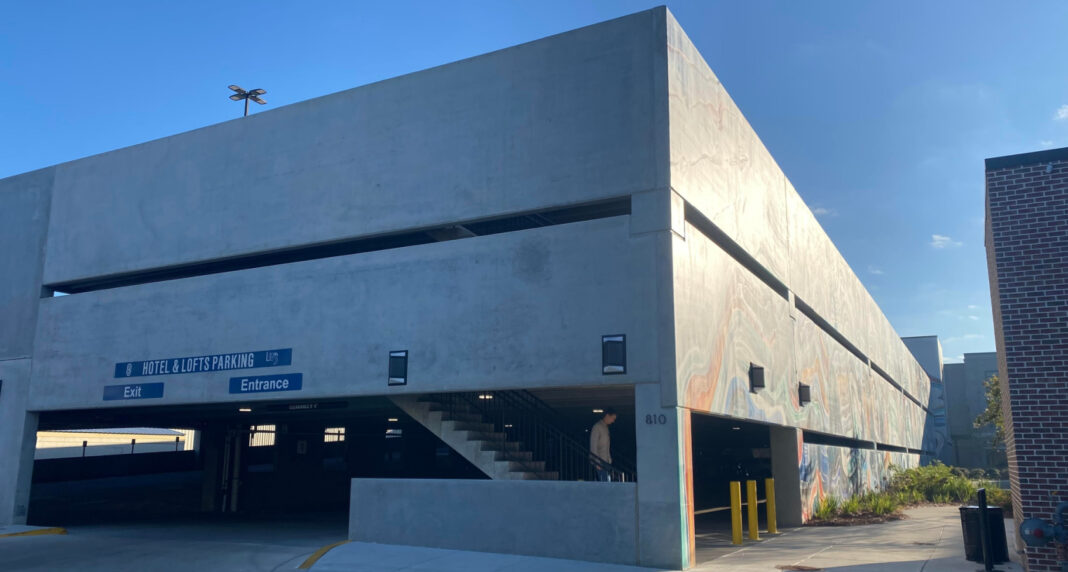
OCEAN SPRINGS, MS (GC WIRE) – For months, city officials presented a version of events to the public and its aldermen — one that built a powerful argument based entirely on facts that didn’t actually exist.
Some critics of the most recent quagmire took a hard line opinion: The city was not bound to lease or to take any part of an $8 million grant that funded the downtown parking garage, because the grant agreements had been signed by a mayor who was never authorized to do so.
This belief, which was also a legal theory mentioned in several GC Wire reports, was based on information provided by the city and its City Attorney – information that would eventually prove to be misinformation.
The question now is: Why?
Why did city officials delve out misinformation to the public and aldermen?
Public Records Mismatch
In March, GC Wire made a public records request asking for very specific information:
“Any resolution, motion, or vote of the Ocean Springs Board of Aldermen authorizing the Mayor and/or City Clerk to execute the GCRF grant agreement for the 1515 Government Street project.”
That request was answered with two documents:
- a July 2019 resolution authorizing the city to be a co-applicant for a grant, and
- an August 2021 Memorandum of Understanding for a potential lease of the garage
But neither of those documents contained any language authorizing the mayor to sign future agreements that would bind the city to millions of dollars in grant money funded by the Gulf Coast Restoration Fund (GCRF).
The fact that each of those documents are from years before the grant agreement in question even existed makes the city’s response even harder to swallow. City Attorney David Harris seemed to agree.
City Attorney Hands Aldermen an Out
In reviews of other grants the city participated in, each had a specific line item in the agenda of a Board meeting that specifically authorized the mayor to execute a grant agreement. According to the city’s records keepers, the GCRF grant for the parking garage did not.
City Attorney Harris confirmed this information in a confidential memorandum distributed to aldermen in November.
In that memo, Harris informed Board members of the state’s “Minutes Rule,” a statute that says a city cannot execute a contract unless it is authorized to do so by the Board of Aldermen. Specifically, Harris wrote:
“If the board approves a contract, the terms of the contract and the board’s approval must be clearly stated in the minutes. If the minutes do not reflect the action, the contract is not enforceable against the municipality.”
He then listed a timeline of all garage related actions taken by the Board in what he referred to as the result of his “independent research and investigation.” Nothing in his timeline equated to an authorization by the Board of Aldermen for the mayor to execute a grant agreement with the state.
By his own legal theory, the grant agreements signed between 2022 and 2024 by then-Mayor Kenny Holloway were unenforceable. In other words, Harris relayed to the Board that, due to the Minutes Rule, they had an out.
The Record That Changes Everything
But none of that may matter. The foundation of the authorization debate falls apart if the previous Board actually did authorize the mayor to sign the agreements and the city was just choosing not to tell anyone.
Buried in the City’s own minutes, GC Wire found the record that changes the entire argument.
On May 17, 2022, months before the grant agreements were signed, the Board of Aldermen took a direct vote on the issue:
“The Mayor said he and the Board had received the Mississippi Development Authority (MDA) Gulf Coast Restoration Fund (GCRF) Program Grant Agreement regarding the parking garage at 1515 Government Street. A motion was made by Alderman Blackman, seconded by Alderman Impey, and unanimously carried to authorize the Mayor to execute the MDA / GCRF Program Grant Agreement.”
That vote does exactly what critics — and even the City Attorney’s own investigation — said never happened.
It authorized the former mayor to sign the grant agreement.
Why the Misinformation?
The implication is difficult to ignore.
The same City that:
- told GC Wire no such authorization existed,
- provided documents that did not match the request, and
- relied on those same documents to shape its legal position,
had already recorded the authorization in its own minutes.
It wasn’t hidden in a contract. It wasn’t buried in legal language. It was a single motion. A single vote. Clearly stated.
The argument that the mayor was never authorized — the one relied on by some critics, echoed in legal discussions presented to aldermen, and reinforced by the city’s own responses — collapses under that record.
The Board had authorized the agreement. The city and its attorney just didn’t tell us.
So the question becomes: Why?
How does a clear, recorded vote — one that directly answers the very question being debated — go unmentioned in public records responses, omitted from a legal memorandum, and never raised while that argument took hold?
There are explanations.
It could be a failure on the part of the records custodian to locate a motion that sat plainly in meeting minutes.
It could be officials working from an incomplete set of records, each reinforcing the same mistaken conclusion. But that wouldn’t explain how GC Wire was able to locate it on the city’s own online archive.
There is another possibility — one that raises more uncomfortable questions:
That the omission wasn’t just an oversight, but a form of misdirection.
That by allowing critics and even members of the Board to rely on an argument built from misinformation, the city preserved the ability to later point to the full record and say: it was there all along.
If so, it would not be the first time aldermen were led to believe something untrue in the matter. In October, the Board of Aldermen was given a copy of an agreement passed by the previous Board, but it was doctored, making them think the city was obligated to pay more than they should in garage related expenses.
Even as recently as this past Tuesday, the Board debated and eventually scheduled a workshop to go over all garage related materials before making a final decision on where the city stands in the potential lease situation — only to find out in a later closed door session the mayor and city attorney had already sent finalized copies of the lease to the developers.
Either way, an argument about grant agreement authorization that never should have existed took root — built not on the full record, but on misinformation that was provided to aldermen and the public.
Does This End the Debate on the Downtown Parking Garage?
Not by a longshot.
The newly identified vote may undercut the argument that the mayor lacked authority to sign the grant agreements. But it doesn’t resolve the larger question being asked by critics — it just shifts it.
Many in the community still argue those same agreements contain another requirement, one that raises its own set of problems.
When the city executed the GCRF grant agreements, it certified that the information provided in the underlying applications was true and correct.
Those applications repeatedly stated that the City of Ocean Springs would own the parking garage.
Not lease it. Not partner on it.
Own it.
And the dirt below it.